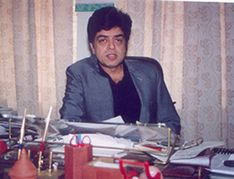
Mukesh Sharma is not the kind of guy you would expect to find in a government job. Suave and with filmstar like good looks, Sharma has, however, been doing exactly that for the past 20-odd years. First with the Children‘s Film Society from 1980 onwards and then with Doordarshan from 1992 in various capacities until he was appointed as the director of the Mumbai Kendra of Doordarshan in May 2000.
Sharma heads DD Sahyadri at an extremely difficult time. The channel is under attack from a clutch of private players: Alpha Marathi, ETV Marathi, Prabhat, and Tara Marathi.
His immediate task, when he took over, was to slash red tape, revamp the programming, give it a fresh look so that it jelled with the denizens of one of India‘s most important states - Maharashtra - and Marathi speaking audiences.
There are several firsts Sharma has notched up for DD Sahyadri: today DD employees undergo performance appraisals, his office is open to respond to queries, something which is anathema in most government organisations, where babudom reigns.
Indiantelevision.com‘s Anoop Wanvari spoke to Sharma who was quite candid on several issues relating to DD, the industry and television in general.
Excerpts:
|
How and where did you start your career in media? I have worked as production chief with the Children‘s Film Society, from July 1980 to May 1992. During that tenure, I directed and produced several feature films. I organised children‘s film festivals in India and abroad and was actively associated with the marketing of children‘s films. Who did you work with and did you win some laurels during this period? I have worked with people like Satyam Bose to Kedar Sharma and even with some renowned south Indian producers. My training has been ek master ke neeche (under the great master); that‘s why I could do so much. I have received calls from other DD channels, seeking advice on how to make improvements. I was even invited by the BBC to explain how could so much be achieved by an individual in a government setup.
What is your work credo and how have you achieved it? How did you go about recreating DD Sahyadri? In my opinion it is easier to start a new channel in such a scenario. I was working within a particular environment for DD and had to consider several things in the revamp. We are running a mandatory public service broadcast organisation and have to always to do a balancing act. The efforts put in are different, we have to reach people and gain acceptance. We decided to change and put in a lot of new programs as content had to be improved substantially. New packaging and presentation were done for all the shows. It was made mandatory to get a technical okay before any programme could be telecast (something similar to ISI standards). New young talent was introduced, new five minute programme slots were created. There were daily discussions on socially relevant topics like alcoholism, dowry, law, health and women‘s issues. Additionally, this was communicated to viewers at large: we held regular press meetings and conferences to boost the image of the channel. Can you be more specific about your programming efforts? Other programmes along these lines are: Hello Sakhi, (targeted at women pertaining to fashion, beauty, food, diet childcare, family problems etc.) Hello Doctor (online consultation with eminent doctors), Hello DD (live phone-ins with personalities from all walks of life), and a sex education programme on Saturday which is telecast live with no editing. Game shows such as Saap Shidi, which is a snakes and ladders game with live participation, Aaj Atta Tabadtob (a phone in quiz) and Chala Banuya Roadpati (a spoof on Star Plus‘s Kaun Banega Crorepati) were introduced. Some of the other programmes include Sanga Utar Sanga (quiz program), Dum dama dum (for children along the lines of Sony Entertainment‘s Boogie Woogie), Kala Darpan (based on heritage, culture and music of tribal and rural folk) Spot light (Marathi film and play appreciation), Tarangan (five minute snippet on Marathi artistes), Raag Ek Raag Anek (based on Indian classical music) Padgham (channel promotions) and Chalta Bolta (a mobile camera team on the move talks to people in Maharashtra in a quiz format), talk shows like Nati Goti (a celebrity chat show) and Samora Samor (a personality based talk show). Additionally, two news bulletins were introduced and experts were invited to review an issue for the day in a 30-minute current affairs show at 9:30 pm. Today, DD Sahyadri has a programming mix consisting of 41 per cent information, 44 per cent entertainment, seven per cent education and eight per cent other genres. Any particular programmes which are positioned as channel drivers? What did you do to improve the work culture prevailing in the Kendra? Nowadays, we discuss what was done yesterday, what targets were achieved. Why there were any reasons for success or failure. We discuss everything threadbare with the people concerned and what rectification or changes can be made. We even ask for feedback from people. All the daily in-depth programme meetings with the staff have helped the channel overcome inherent production and technical problems. After the meeting, I draw up a chart for what is planned for the day and the timings. This have been so well-organised that even in my absence things move on without any hitch. Everybody concerned is made aware of what‘s going on. In fact even the peon knows what‘s to happen and is quite miffed that there is no kichdi to pakao (no rice to cook). Everything is so transparent. I feel if you do things with a clean heart success is bound to follow
How much of a free hand do you have in deciding matters? Are your hands tied by politicians or bureaucrats? What results have you achieved? More specifically how are you performing in revenue terms?
How are you positioned against the other regional channels under the DD umbrella? What is your opinion about the alleged TRP scam? This expose carried by CNBC is an overall loss for the television industry. The rating agencies are doing a good job. There should be a level playing field for all the players in industry and this expose was unethical by all means. Doordarshan Sahyadri was not affected in any way by this expose. The reach of this channel is very large and it is very well connected. Do you think you need to be multi-skilled in a creative business like television? |