
VBS 2026
Automation reshapes live sports and news broadcasting
Industry leaders map AI-driven shift from stadium to screen.


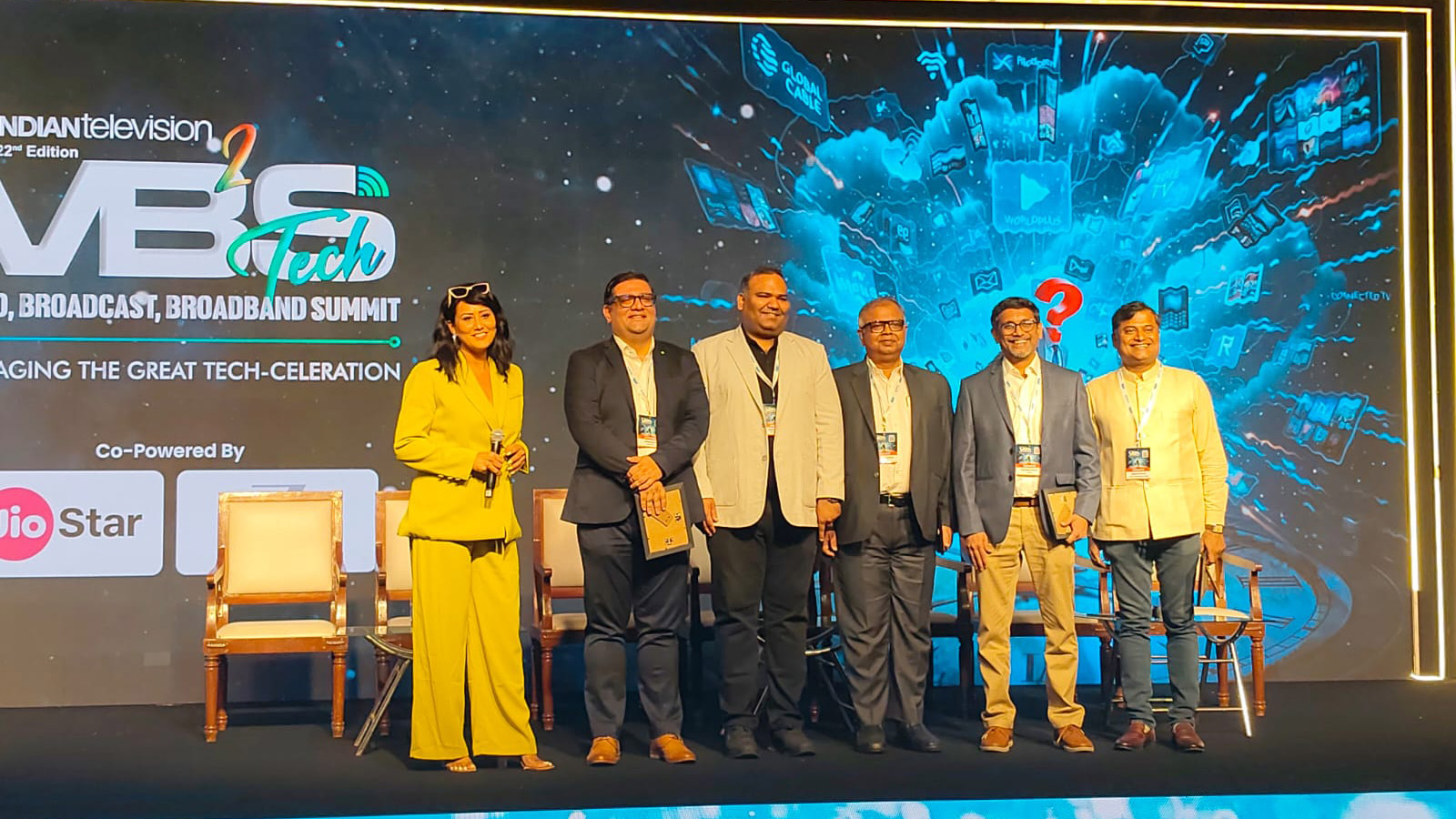
MUMBAI: From the roar of the stadium to the glow of the smartphone, the journey of a live moment has never been more engineered. At the 22nd edition of the Video Broadcast and Broadband Tech Summit hosted by IndianTelevision Dot Com, technology heads and media strategists unpacked how automation is rewiring the entire production chain from on-ground capture to studio control rooms to final streaming delivery. The session, titled The Journey From Live Events Sports and News To Viewers Exploring Tech Driven Production, made one thing clear: the magic of live television now runs on code as much as cameras.
The panel brought together Mukund Acharya, CTO at Sony, Bhaskar Majumdar, GM SAARC at Ross Video, Divyajot Ahluwalia, Founder and Director at wTVision and Quidich Innovation Labs, Megha Gambhir, CEO and Founder of Stupa Sports Analytics; Subodh Aggarwal, General Manager South Asia at TVU Networks, Anand Pimprikar, Head India and Middle East at Tata Communications Media Enabled Services, Rohan Padha, Partner India at Deloitte, with Pimprikar chairing the session.
Divyajot Ahluwalia highlighted how artificial intelligence is now uncovering insights invisible to traditional analysis. “We are developing models that are able to find stories hidden inside data which statisticians could not see otherwise,” he said. In sports broadcasting, that means deeper narratives layered into commentary patterns, probabilities and player insights surfaced in real time.
Megha Gambhir underlined how precise data has changed storytelling. When a commentator narrates a match, they can now lean on percentage-based statistics and contextual metrics to support analysis. “Going on-air with something wrong can damage a lot,” she said, noting that AI-driven verification tools are helping ensure accuracy.
Live data feeds are also opening commercial doors. Gambhir pointed out that some live data is provided by sponsors with promotional integration built in, creating new advertising inventory for sports broadcasters. Data, in other words, is no longer just editorial fuel, it is monetisable real estate.
Mukund Acharya described the transformation in scale. “The big shift is that the scale at which we broadcast these programmes has become very much possible from a technical point of view,” he said. Sony LIV, he revealed, saw 10 million concurrent viewers during a major event, a milestone achieved because the platform was engineered for even higher peaks.
That preparedness is crucial. “Live streaming is the most exciting thing because so much is happening and anything can go,” Acharya said. Systems must be built to withstand unknown failures. Behind the scenes sits an orchestration layer controlling feeds, graphics, switching and distribution invisible to viewers but central to reliability.
Subodh Aggarwal added that AI-based automation often remains unseen by audiences. “People would never know on the viewer side, but it will always be on the production side,” he said. The invisible engine room is increasingly automated.
Cost and infrastructure dynamics have shifted as well. Aggarwal noted that scalability, once constrained by hardware and physical infrastructure, has improved significantly, enabling cost savings. At the same time, he cautioned against over-reliance on 5G networks for real-time sports broadcasting. AI-based optimisation helps enhance reliability and performance when network conditions fluctuate.
COVID accelerated the move to remote production. Anand Pimprikar observed that many Tier 1 productions had not fully embraced network-based workflows before the pandemic. The crisis forced change. “Most of these networks don’t have data centres; you have to build it as you go along,” he said, describing a landscape still evolving.
Rohan Padha highlighted structural changes across the value chain. As production models shift from on-site hardware to distributed, cloud-enabled systems, the economics and operational logic of broadcasting are being rewritten. Viewers are also engaging differently. “A lot of viewers are engaging with content in a different manner; they are going more in-depth,” he said.
That shift dovetails with hyper-personalisation. Technology now allows tailored graphics and contextual overlays for different audience segments. “Advertisers are going to have the best access to their customers now,” Ahluwalia noted, as personalised graphics and targeted data become embedded within live streams.
Majumdar added that as personalisation increases and viewers consume across multiple platforms, expectations for crisp visuals and higher broadcast quality are rising sharply. Precision is no longer a luxury, it is baseline.
For Bhaskar Majumdar, automation is no longer experimental. “Automation is here, it is bread and butter for us,” he said. Yet he was quick to dispel fears. “The biggest myth is that AI will take away your job. AI is your friend in English, it is your butler. It is there to help you.”
Acharya echoed that sentiment, suggesting India is uniquely positioned to lead in handling scale efficiently. “We can teach the world how to handle scale with the ROI we produce,” he said. Majumdar pointed to the creativity displayed during India’s general elections among the largest democratic exercises in the world where data-driven graphics and storytelling reached levels he had not seen elsewhere.
Aggarwal offered a pragmatic takeaway. “If you make a product taking India into consideration, it will work anywhere in the world,” he said, referencing the country’s complex, cost-sensitive and high-scale environment as a testing ground for global-ready solutions.
Across the discussion, one theme stood out. The viewer sees the final whistle, the breaking news ticker or the celebratory graphic. What they do not see is the orchestration layer quietly managing feeds, the AI models checking statistics, the automation scripts triggering graphics, or the cloud systems absorbing traffic spikes from millions even 10 million of concurrent viewers.
The journey from live event to living room is no longer linear. It is data-rich, algorithm-assisted and increasingly personalised. And while cameras still capture the moment, it is automation that ensures the moment arrives intact, accurate and on time.
In the age of intelligent production, the show still goes on only now, it goes on with a little less hard labour and a lot more smart engineering.






