Event Coverage
Voice beats text, scenes beat search: JioHotstar bets big on talking telly
At APOS 2026, JioStar’s top brass sketched a future where viewers chat their way to content, shop mid-show and 100 million connected TVs do the heavy lifting

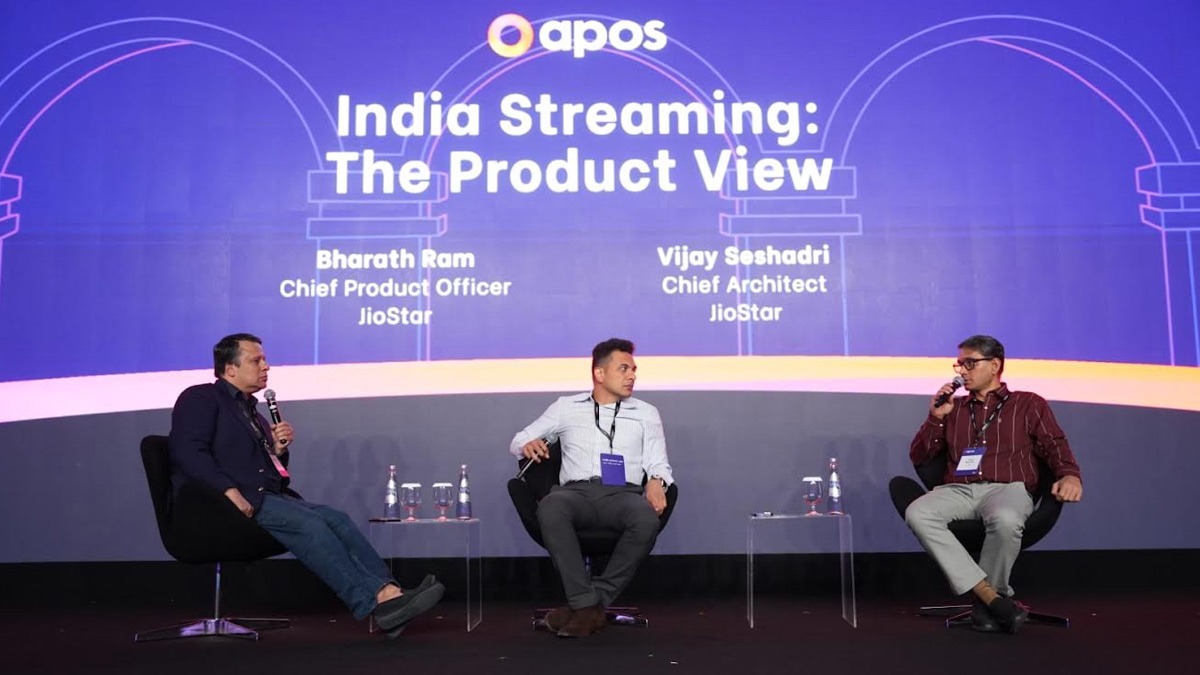
Bali: Streaming in India is done typing. At APOS 2026, Bharath Ram, chief product officer, JioStar, and Vijay Seshadri, chief architect, JioStar, laid out a platform quietly rewiring itself around conversation, context and commerce, and the numbers backing the pivot are eye-watering. In a session titled “India Streaming: The Product View”, moderated by Vivek Couto, chief executive of Media Partners Asia, the pair traded notes on what it takes to keep one of the world’s largest streaming audiences hooked, habituated and, increasingly, shopping.
Ram opened by laying out the philosophy underpinning every decision at JioHotstar. “A lot of product vision starts with the consumer experience and works backwards from it,” he said, describing a constant balancing act between acquisition, retention and long-term value, where “product and engineering come together.” Seshadri agreed the two functions are inseparable at this scale: “Product defines the ‘what’ by grounding decisions in customer problems, while engineering focuses on the ‘how’ by building solutions at scale,” he said, adding that on a platform like JioHotstar, “engineering doesn’t just execute the vision; it helps shape the capabilities that make that vision possible.”
That tension between simplicity and scale shows up most starkly in how JioHotstar handles India’s wildly uneven consumer base, spanning mobile-first users on entry-level plans to premium connected-TV households. Ram’s answer is to resist over-engineering the differences. “India is an incredibly diverse market, and our consumers have very different viewing habits depending on the devices they use and the experiences they seek,” he said. “The product should stand between the consumer and the content as little as possible.” In his words to the session itself: “The sooner you can remove yourself out of the way and give consumers the content they want to watch and the experiences they want to go through, the retention cycle kicks in automatically.”
The same logic extends to how JioHotstar prices itself. Rather than a single, all-encompassing subscription, Ram described a deliberately staggered approach. “Consumer acquisition doesn’t have to be an all-or-nothing proposition,” he said. “The better approach is to create accessible entry points that make sampling easy and then build pathways for consumers to upgrade based on their preferences and willingness to pay.”
That philosophy is being tested at genuine scale. Connected TVs in India are closing in on the 100 million mark, and JioHotstar’s job now is less about acquisition than habit-formation: more days a month, more months a year. IPL 2026 did some of that work already, nudging mobile-first viewers up the chain towards bigger screens. Underneath it all sits engineering plumbing built for stress: Seshadri pointed to subscription spikes during marquee live events touching nearly 5 million requests per minute, a load the platform has had to learn to spread out rather than let crash headlong into India’s UPI-heavy payments rails.
On discovery, the headline statistic is striking: more than 60 per cent of users now choose voice over text when JioHotstar’s conversational discovery tool, built in partnership with OpenAI, gives them the option. Seshadri called it the first real shake-up in the space in decades. “Nothing much has changed in content discovery in the last 15 to 20 years,” he said. “While recommendation engines changed the industry once, we believe the next major shift is conversational discovery, where people interact with platforms naturally instead of searching with keywords. In India, voice adoption is accelerating this transition.” He elaborated on the design behind it: “We’re already seeing strong consumer adoption of conversational interfaces. When people have the option of interacting through voice or text, many naturally gravitate towards voice, especially in a market like India.” The tool fuses natural language with visual recommendations, letting a viewer open with broad intent, “like finding something to watch with family,” and progressively narrow it down to something highly personalised.
Seshadri was equally insistent that the generative AI hype cycle is missing half the story. “A lot of the conversation around AI focuses on content generation, but there’s an equally important opportunity in what I would call the derivative layer,” he said, describing the task of mining intelligence from libraries that already exist to power “semantic discovery, richer audience experiences and entirely new commerce opportunities.”
That derivative layer has a name: JAMS, JioHotstar’s video intelligence layer, and arguably the session’s most provocative thread. By making content machine-readable down to the level of individual scenes, people, products and objects, JAMS is quietly dismantling the wall between watching and buying. “If you truly start peeling the layers of the onion and understanding what the items within a piece of content are, the separation between content and commerce starts thinning,” Ram said. He went further on the mechanics of it: “As AI makes content more machine-readable, we’re beginning to see the traditional boundaries between content, advertising and commerce become much more fluid. Instead of interrupting a viewing experience, you can create contextual interactions where products are discovered naturally within the content itself.”
Interactivity, in Ram’s telling, is the bridge that makes all this possible. “The next evolution of streaming is about moving from passive viewing to active participation,” he said. “We want consumers to lean forward and interact with the content they love, whether that’s through games, companion experiences or other forms of engagement.” Jeeto Dhan Dhana Dhan, JioHotstar’s cricket-companion game, and its integration with Swiggy were cited as early proof that the habit is already forming.
Seshadri closed by naming where all of this is heading. “One of the biggest consumer behaviour shifts over the next few years will be the move towards conversational commerce,” he said. “Just as AI is changing how people discover content, it will also change how they discover and purchase products and services.” His sharpest line of the session left little room for ambiguity: “The next sector to be disrupted is product commerce. A platform like ours that can crack a seamless purchasing experience while watching content could see a transformative change over the next 12 months.”
Conversational interfaces, connected screens, contextual commerce: the session’s throughline was unmistakable. JioHotstar isn’t just streaming any more, it’s building the rails for India to talk, tap and buy its way through entertainment, and betting the next 12 months will prove just how far that can go.