Brands
TV bills on the rise: JioStar, Sony, and Zee crank up prices by 10 per cent
Broadcasters tune into higher tariffs as JioStar, Sony, and Zee reveal new prices

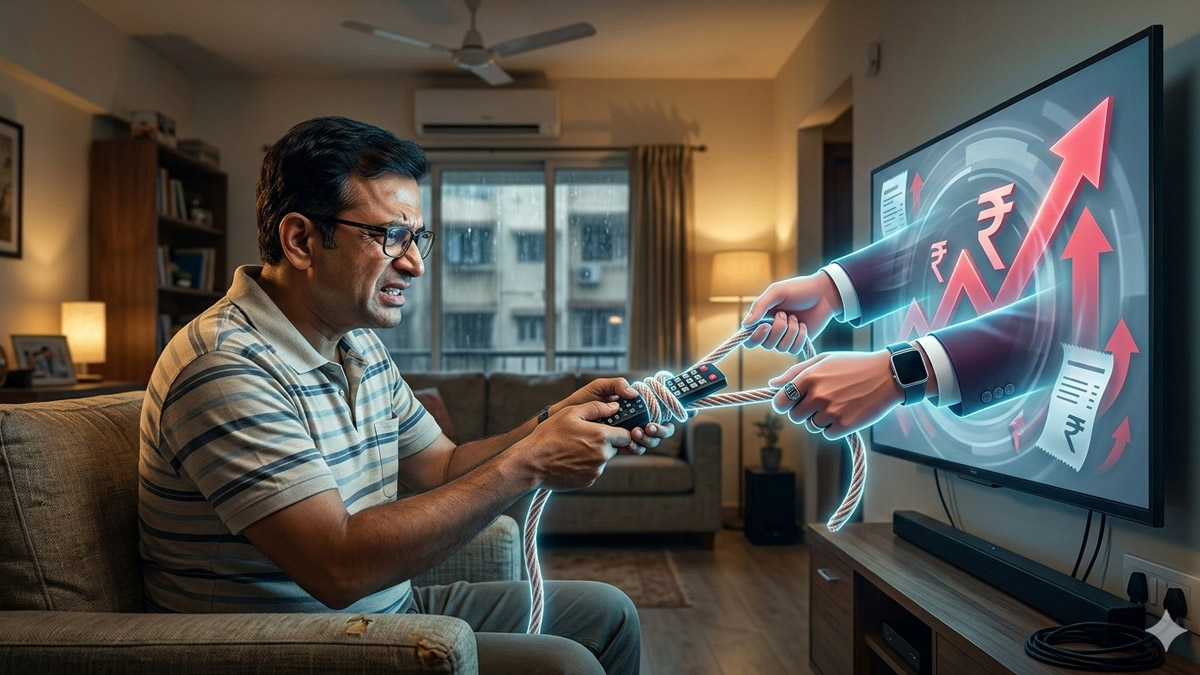
MUMBAI: If you were hoping for a cheaper night in front of the telly next year, you might want to look away from the remote. India’s broadcasting giants are flipping the script on pricing, with JioStar, Sony, and Zee all tuning into a new frequency of higher tariffs. Ahead of the 2026 financial year, the Big Three have released their updated Reference Interconnect Offers (RIOs), signalling a collective push that will see most monthly bills rise by roughly 10 per cent.
The synchronised move suggests that broadcasters are testing the price elasticity of their audience. In simpler terms, they are betting that your love for daily soaps and live sports is stronger than your annoyance at a slightly lighter wallet.
Sony is making a particularly bold play in the High Definition space. If you enjoy the crispness of Sony Entertainment Television HD or Sony SAB HD, your monthly bill for those channels will jump from 25 rupees to 30 rupees. The same 30-rupee price tag now applies to their sports heavyweights, including Sony Sports Ten 1, Sony Sports Ten 2, Sony Sports Ten 3 Hindi, and Sony Sports Ten 5.

However, Sony is also expanding its horizons. Fans of regional content have new arrivals to look forward to, provided they are patient. Sony Sports Ten 4 Kannada is slated for an April 2026 debut, while Sony Vizha and Sony Vizha HD are expected by June. By August, Sony Telugu and Sony Telugu HD should be live. To keep customers sweet until then, Sony is offering “proportionate discounts.” For instance, the Happy India 2026 Smart Tamil bouquet, normally 42 rupees, will cost just 29.91 rupees until the new Vizha channel officially joins the party.
On the standard definition front, Sony is keeping its “strategic mass price” at 19 rupees for big hitters like Sony Max, Sony Marathi, and Sony Aath. Smaller channels see minor tweaks: Sony Max 2 is nudging up from 2 rupees to 3 rupees, while Sony Yay! sits at 6 rupees and Sony Max 1 remains at 5 rupees.
Zee Entertainment is also getting in on the act with a comprehensive 10 percent hike. Their flagship Standard Definition channels, such as Zee TV, Zee Cinema, Zee Marathi, Zee Bangla, Zee Sarthak, Zee Kannada, and Zee Tamil, are all locked in at 19 rupees. Interestingly, they have matched this 19-rupee price point for many of their HD versions too, including &TV and &Pictures.
For those who prefer the all-you-can-eat bouquet approach, Zee’s All-in-One Hindi SD pack has risen to 58 rupees. Their Marathi and Bangla packs are now 64 rupees, while the Southern trio of Tamil, Kannada, and Telugu SD packs will set you back 85 rupees. If you want those same Southern packs in glorious HD, the price climbs to a steeper 131 rupees. Zee is also shuffling its deck by exiting English entertainment but entering the sports arena, with Zee Cafe and &flix seeing price adjustments to 7 and 8 rupees respectively.
JioStar is perhaps the most aggressive of the bunch when it comes to regional favourites. While they have kept core Hindi staples like Star Plus, Colors, and Star Gold at 19 rupees, they have pushed premium regional channels like Asianet, Colors Kannada, Vijay TV, and Maa TV up to 30 rupees. This move is significant because any channel priced over 19 rupees cannot be included in a discounted bouquet, meaning fans of these channels will have to buy them separately, potentially driving up the total cost of a monthly subscription.
Even the youngsters aren’t spared, with kids’ favourites like Nick SD and Nick HD+ now priced at 19 rupees. As we head towards April 2026, the ball is now in the court of the cable and dish operators. They must decide how much of these increases they can swallow and how much they will pass on to the person holding the remote. For the average viewer, the message is clear: premium content is getting a premium price tag.







Brands
India exports $2.5 billion worth of Apple components to China under ECMS push
Component push and policy boost turn India into unlikely supplier hub

MUMBAI: India’s electronics trade story is getting a plot twist. What was once a one-way flow from China is now starting to reverse, with exports of electronic components from India to China hitting a record $2.5 billion in FY26 so far, and projected to reach $3.5 billion by the end of the fiscal year.
At the heart of this shift is the growing manufacturing ecosystem built around Apple and its suppliers. Companies such as Tata Electronics, Pegatron, Foxconn, Salcomp, Motherson and Yuzhan Technology are driving the surge, transforming India into a key node in global supply chains.
Just a few years ago, exports of such components were negligible. Today, they are part of a rapidly expanding multi-billion dollar ecosystem, fuelled by scale, quality improvements and tighter integration with global production networks.
A major catalyst behind this growth is the government’s Electronics Component Manufacturing Scheme, launched in 2025. Unlike earlier incentives focused on assembling finished devices, the scheme targets high-value components such as circuit boards, camera modules and enclosures, offering both turnover-linked and capital expenditure incentives.
The logic of exporting components to China, long seen as the “factory of the world”, may seem counterintuitive. But the shift reflects a deeper realignment. As Apple scales production in India, now accounting for roughly 25 per cent of global iPhone output, local suppliers have become competitive enough to feed into global assembly lines, including those in China.
This is also part of a broader “China+1” strategy, where companies diversify manufacturing bases to reduce geopolitical risk. India-made components are increasingly being routed back into Chinese factories to maintain global supply continuity.
At the same time, India’s domestic value addition in smartphones has climbed to around 20 per cent, signalling a move beyond basic assembly towards more sophisticated manufacturing.
While India continues to import heavily from China, the emergence of a $3.5 billion export pipeline marks a meaningful shift in direction. Electronics are now joining engineering goods and agriculture as key drivers of India’s exports to China, which are expected to cross $18 billion this fiscal year.
In short, India is no longer just assembling the world’s gadgets. It is beginning to help build them, and in some cases, even supplying the very factories it once depended on.







