MAM
The ad business is on fire, and everyone’s arguing about the curtains
Bigger holding companies, smarter algorithms, thinner margins, the industry is optimising for scale when the market is rewarding speed.

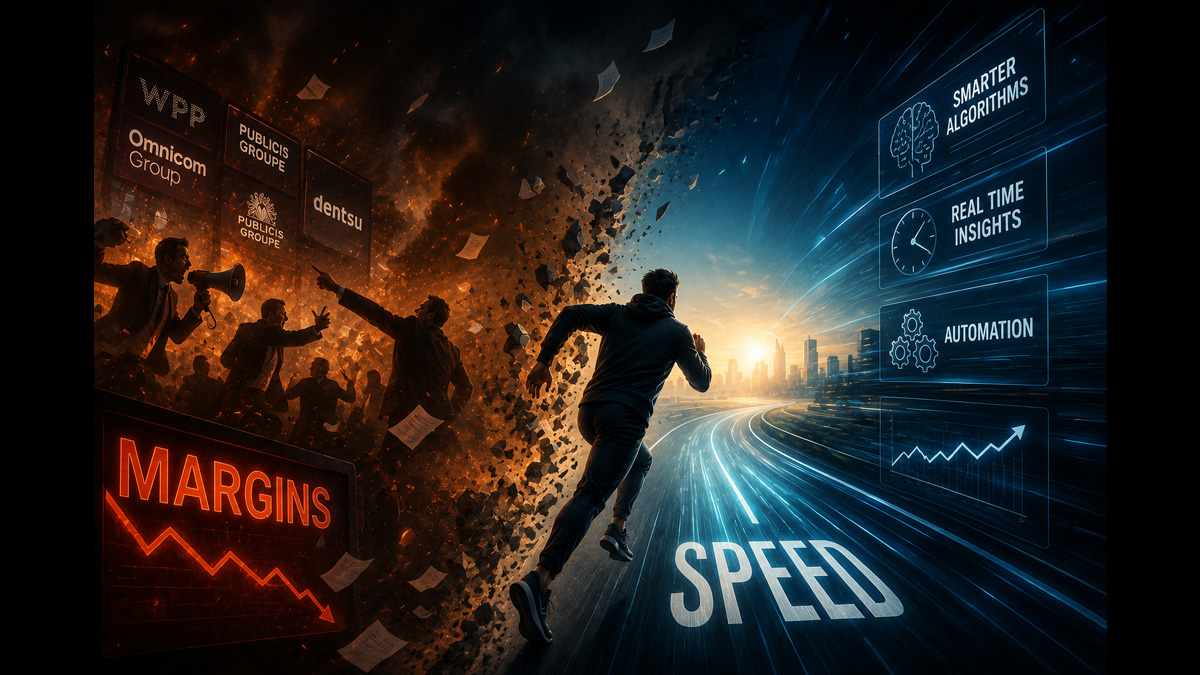
MUMBAI: The advertising and media agency business loves a good funeral. It has been burying “traditional advertising” for two decades now, with great ceremony and greater PowerPoint decks, while quietly cashing the same commission cheques. But this time the fire alarm isn’t a drill. Generative AI, retail media, AVOD streamers and a new breed of solo AI-powered creators are simultaneously chewing through the industry’s revenue base, its talent pipeline and its reason for existing and the response from the world’s biggest holding companies has largely been to merge, rebrand and pray.
Let’s take this apart, agency by agency, region by region, before the next earnings call does it for them.
Omnicom swallowing Interpublic Group to create a roughly $25-billion behemoth leapfrogging both Publicis and WPP to become the largest ad holding company on the planet is the headline act. Legacy names like IPG Mediabrands have already been retired and folded into a single Omnicom Media platform, with UM, Initiative and Mediahub absorbed wholesale. WPP has done its own quiet burial, retiring GroupM itself in favour of WPP Media, and brought in Cindy Rose, a former Microsoft executive, as chief executive to signal that this is now a technology company that occasionally sells 30-second films. Publicis, meanwhile, has spent years positioning itself less as a network of agencies and more as a data-and-AI platform that happens to have some creative directors on the payroll.
Here’s the uncomfortable question nobody at these press conferences wants to answer: is any of this actually about getting better at advertising, or is it about getting big enough to survive a shrinking pie? Because the pie is shrinking, or at least being sliced by hands that never used to be at the table.
Retail media and e-commerce platforms Amazon, Walmart Connect, Flipkart, Reliance’s ad stack, Blinkit have quietly become some of the fastest-growing ad businesses on earth, and they don’t need a creative agency to sell a banner against a purchase intent signal. Streamers with AVOD tiers Netflix, Amazon Prime, JioHotstar, Z5 are building their own ad-sales machinery and increasingly their own measurement, bypassing the media agency’s traditional value proposition of “we know where the eyeballs are.” And then there is the newest, rudest disruption of all: individual creators armed with generative AI tools who can storyboard, shoot, edit and publish a piece of branded content that outperforms a client’s Rs 2-crore TVC, in a fraction of the time, at a fraction of the cost, with none of the network overhead.
Add to this a chief marketing officer class that has been thoroughly re-educated by chief financial officers to demand hard, attributable return on investment on every rupee and dollar spent no more “brand building” hand-waving, no more awards-show vanity metrics — and you have a business under assault from every direction at once: from the platforms eating the budgets, from AI eating the production cost, and from clients eating the margin.
While the holding companies were busy merging logos, a whole tier of digital-first, performance-led agencies quietly built real businesses on the back of exactly what clients now demand: measurable, attributable, ROI-first outcomes. Schbang, Social Beat, Tonic Worldwide, White Rivers Media, BC Webwise, are good example of a much larger pattern scores of independent digital shops across India and globally that never had a TVC-and-Cannes-Lions legacy to defend, and so never had to unlearn it. They grew up native to performance marketing, search, social and marketplace advertising, reporting revenue and conversion numbers rather than reach and recall scores, and billing on outcomes rather than a percentage of media spend.
That is precisely the muscle the big networks are now scrambling to bolt on via acquisition. The irony is rich: the holding companies spent the 2010s dismissing performance shops as tactical, lower-order vendors unworthy of the strategic table, and are now paying premium multiples to buy that exact capability back. The digital-first insurgents don’t need to out-merge anyone. They need to keep scaling what they already do well, resist the temptation to over-staff and over-structure themselves into mini-holding companies, and use AI to compress their own delivery costs before a bigger rival does it to them first.
India’s version of this story has its own cast of characters, and it’s worth naming them, because the pattern is the same trade dressed up in local logos. Dentsu didn’t build performance-marketing depth in India organically, it bought Merkle Sokrati, folding a homegrown analytics-and-media-buying shop into a global data platform to go after the large-ad-spend, enterprise end of the market. IPG did the same thing years earlier with Interactive Avenues, one of India’s earliest digital-pure-play agencies, now running inside IPG Mediabrands. And Kinnect — the social-first shop behind much of the Mamaearth, Wow Skin Science and Sugar Cosmetics playbook sits inside a joint venture with FCB, part of the same Interpublic family, while still trading heavily on its founder-led, independent reputation.
The logic for the acquirer is straightforward. Building genuine performance DNA, the search and social execution muscle, the attribution tooling, the D2C client references takes years to grow organically inside a TVC-era agency culture; buying it is faster. It gives the network something to say when a CFO-trained CMO asks for attributable ROI instead of a reach-and-recall deck. It opens up cross-sell into existing enterprise retainers, a BFSI or FMCG client already paying for brand and media can be upsold into performance work without a fresh pitch. And in most of these deals, the network buys the founders along with the client book, because the operator instinct is exactly what a matrixed network doesn’t have in-house.
But it is not a free lunch, and the fine print shows up first in how the client experiences the agency, not in the press release announcing the deal. The scrappiness that won the client in the first place is the first casualty founder-led shops win pitches by being fast and unbundled, and once that shop is folded into a network P&L, procurement processes, legal sign-offs and reporting cadences from the parent tend to slow decision cycles down, which is the opposite of what the client thought it was buying. Performance shops were built on lean, outcome-billed economics; network integration usually means absorbing holding-company overhead that client budgets end up quietly subsidising. There’s a brand-identity cost too “Kinnect, part of FCB” or “Merkle Sokrati” reads very differently to a founder-run D2C brand than “independent Kinnect” did, and some clients specifically seek out non-network shops for the reasons this piece keeps returning to: platform incentive conflicts, volume over quality, less direct accountability. And the sharpest risk is talent, the people who actually built the performance reputation are rarely the ones locked in through an earnout and a network reorg; if they leave once the vesting clock runs out, the client relationship that was built on those specific individuals erodes even while the logo and the case studies stay exactly the same.
There’s a second-order effect too, and it cuts against the acquirer. Every time a network pays a premium to buy a performance shop, it is a tacit admission that the capability it once dismissed as tactical was actually the more valuable asset in the room which only strengthens the pitch of whichever independents are still standing. Schbang, Social Beat, White Rivers Media and Tonic Worldwide can now credibly tell a prospective client: we’re what they had to go and buy, and we haven’t been diluted. In a market where three networks WPP, Omnicom and Publicis could soon command well over 70 per cent of Indian ad spend post-consolidation, “still independent” stops being a neutral fact about ownership and starts being the entire sales pitch.
Nobody is talking enough about what this does to the TVC production ecosystem, the directors, production houses, editors and post-production studios that have spent decades in a tight, often personal orbit around agency creative heads. That relationship was built on a simple economic loop: the agency sold the big idea, the creative head handpicked a director whose sensibility fit the brief, and a production house turned a script into a 30-second film over several days and several lakh sometimes several crore rupees.
Generative AI breaks that loop at multiple points at once. Storyboards and animatics that once justified a production house’s early-stage fees can now be generated in minutes. Stock and synthetic footage, AI voiceover and even fully AI-generated ad films are already good enough for a large share of digital-first, always-on content needs, the hundreds of small variants and cutdowns a brand needs for performance campaigns, not necessarily the one hero film for a festival or a cricket final. Production houses that built their business purely on volume, the twenty-odd cutdowns, the regional dubs, the social edits are the most exposed. Those built on genuine directorial craft, high-production spectacle and celebrity-led hero films will likely survive, but as a smaller, more premium, more occasional part of the spend, not the reliable monthly retainer it once was. The agency creative head, similarly, moves from being a talent-relationship manager to something closer to an AI-orchestration editor curating and refining machine output rather than commissioning human craft from scratch every time.
Trace the rupee through the value chain and the redistribution is stark. Media owners with first-party data and closed-loop attribution, the retail platforms and streamers are net gainers, pulling budget directly and disintermediating the media agency’s buying commission. Performance and digital-first agencies are net gainers too, provided they keep investing in their own AI tooling rather than resting on early-mover advantage. Holding companies are betting that scale and proprietary AI platforms like Omni let them protect margin even as commission pools shrink — a bet that requires real technology investment, not just an internal rebrand, to actually pay off. TVC production houses, especially mid-tier and volume-driven ones, are the clearest net losers, facing both fewer briefs and thinner budgets per brief. And traditional “big idea” creative agencies sit in the most uncomfortable middle: still commanding respect and awards, but increasingly asked to prove a rupee-for-rupee return that a hero film was never designed to prove.
Scale solves some problems. A combined Omnicom-IPG can genuinely invest more in a proprietary AI stack than either could alone, and cost synergies running into hundreds of millions of dollars a year aren’t nothing. But scale is not the same as relevance, and the industry’s history is littered with mega-mergers that produced bigger balance sheets and worse client experiences. Consolidation reduces choice for advertisers at precisely the moment advertisers want more specialised, more nimble, more AI-native partners which is exactly why independents like Horizon Media, PMG, Tinuiti and Wpromote globally, and performance-first shops like White Rivers Media in India, have been growing share by being the opposite of a holding company: fast, unbundled, technology-first.
If the merged giants spend the next 18 months on integration meetings and redundancy calculations instead of building genuinely better AI-driven output, the independents eat their lunch while they’re busy eating each other. Consolidation is the right gambit only if it is followed, fast, by real product not if it’s simply a defensive reflex dressed up as strategy. On current evidence, it’s roughly fifty-fifty which one this turns out to be.
The Indian market is watching this play out with its own twist. With the Omnicom-IPG merger, the combine becomes the second-largest agency group in India after WPP, and industry veterans reckon that post-consolidation, three networks WPP, Omnicom and Publicis could end up commanding well over 70 per cent of Indian ad spend, at a time when the overall market has crossed Rs 1 lakh crore. That’s an extraordinary concentration of buying power in a market that is simultaneously seeing explosive, fragmented growth in AVOD via JioHotstar, Z5, quick-commerce retail media and a booming independent creator economy on Instagram and YouTube. Layer the Merkle Sokrati, Interactive Avenues and Kinnect acquisitions on top of that, and the picture sharpens further: the networks aren’t just buying media inventory relationships and creative pedigree anymore, they’re buying their way into the exact performance-marketing capability that was supposed to be the independents’ moat.
Concentrating power at the top while the actual innovation is happening at the bottom in performance shops, in creator studios, in retail media desks is not obviously a winning strategy. It’s a bet that scale and AI investment will outrun disruption, and it’s far from a sure thing.
If any of this needed independent confirmation, Cannes Lions 2026 supplied it, dripping in rosé and a 40-degree heatwave. The mood on the Croisette this June was markedly cooler than the breathless AI-optimism of the previous two festivals. The industry has largely stopped debating whether AI will change marketing and moved to the far harder question of how to actually run a business on it implementation, governance and workflow redesign, not keynote hype. That shift in tone alone is a quiet admission that two years of AI theatre produced more slide decks than profit-and-loss impact.
The number that should worry every holding-company chief executive: nearly 60 per cent of marketers now say they use AI multiple times a week, yet barely 10 per cent have actually redesigned their workflows around it. The tool has arrived; the operating model hasn’t. One question did the rounds at every rooftop and yacht party on the Croisette is AI all peanut butter and no jelly, all tech talk and no bottom-line results? That gap between adoption and impact is exactly the gap consolidation is meant to close, and on this year’s evidence, it mostly hasn’t yet.
The second big worry, raised repeatedly across panels, was a phrase delegates kept reaching for: mediocrity at scale. Not just AI slop, but a broader flattening of creative output as more of it gets churned out by the same handful of models trained on the same handful of patterns. That is precisely why PR, earned media, live experience and genuine craft were talked up as staging a comeback, they resist the sameness that generative tools default to. Sport, unsurprisingly with the FIFA World Cup ongoing, was repeatedly framed as one of the last remaining pools of high-intent, emotionally invested attention that AI cannot manufacture or commoditise.
Agentic AI was the buzzword that ate the festival Adobe, Meta, TikTok, Google and, in its Cannes debut, OpenAI itself all showed up with systems designed to plan, launch and optimise campaigns with progressively less human hand-holding. Governance, interoperability and transparency followed close behind as the industry’s uneasy chaperones, an implicit admission that nobody entirely trusts agentic systems let loose on client budgets just yet. And in a smaller but telling aside, one veteran media analyst predicted that vertical, mobile-first “microdrama” content would overtake AI as the most-used phrase at next year’s festival, a reminder that format disruption isn’t finished just because everyone’s busy talking about models.
So what does Cannes suggest by way of course correction? Three things, fairly bluntly. One, agencies need to close the adoption-to-redesign gap fast deploying AI inside a legacy workflow is decoration, not transformation, and the vast gulf between usage and actual workflow redesign is the clearest tell that much of the industry is still faking it. Two, “human” needs to stop being a defensive talking point and become an actual investment line craft, live experience, earned media and genuine creator relationships are the parts of the value chain AI cannot flatten, and they deserve budget and staffing to match, not just a panel slot. Three, measurement has to graduate from buzzword to operating discipline proving incremental, purchase-linked outcomes, not just reach or sentiment, was described by more than one delegate as where the rubber actually met the road at Cannes this year, and it remains where most current AI tooling still falls short.
What actually needs to change. Fewer logos on the door, more genuine AI-native capability inside it. Agencies global and Indian, holding company and independent need to stop treating generative AI as a cost-cutting lever bolted onto old workflows and start treating it as the workflow: content that is personalised, produced at platform speed, measured against hard commerce outcomes, and competitive with what a single sharp creator can do solo. They need to get serious about retail media and commerce as a discipline, not an afterthought bolted onto the media plan. Production houses need to reposition around premium, irreplaceable craft rather than volume, or find a way into the AI-tooling business themselves. Acquired performance shops, for their part, need to fight for genuine operating independence light-touch integration, retained leadership, protected client-facing speed rather than full absorption, or they risk losing exactly the trust the network paid a premium to buy. And everyone needs to stop selling “brand purpose” decks to CMOs who are being asked by their own boards, in plain English: what did that rupee actually buy us?
The bottom line. The industry isn’t dying. But the version of it built on network scale, TVC hero films and quarterly award submissions absolutely is. The agencies, production houses and creator businesses that survive this decade won’t be the biggest. They’ll be the ones that worked out, fastest, that the client doesn’t want an agency anymore, they want a growth partner who happens to be very good with a camera and an algorithm. Everyone else is just rearranging furniture on a very expensive, very sinking ship.