Brands
Auto sector’s TV ad volumes slide as digital triples and print surges, finds TAM AdEx
India’s car and two-wheeler brands are pouring money into digital and print while television ad volumes slide, with Maruti Suzuki India ruling the airwaves, the pages and the algorithms alike

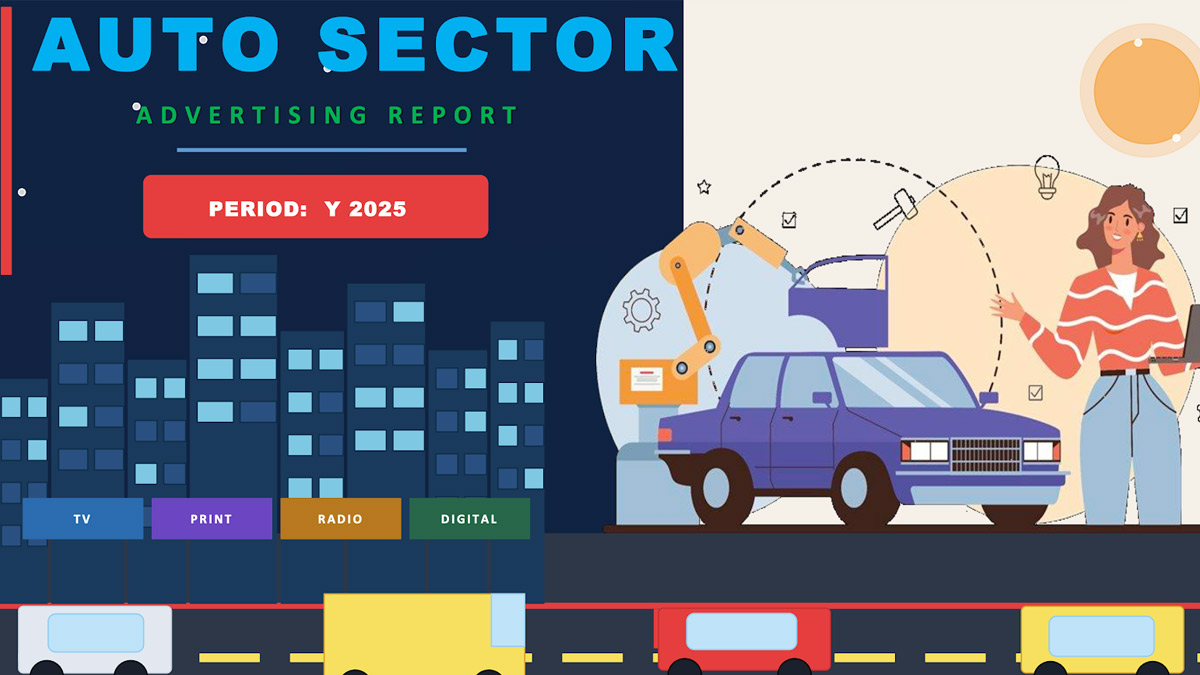
MUMBAI: India’s auto sector advertisers are shifting gears. Television is losing ground, digital is surging, print is booming and radio is quietly doubling up — that is the headline finding from TAM AdEx’s cross-media advertising recap for 2025, covering January to December across TV, print, radio and digital.
The television story is one of steady retreat. Auto sector ad volumes on TV fell 22 per cent in 2025 compared to 2021, with Q2 and Q4 of 2025 posting moderate declines of 12 per cent and 2 per cent respectively. The one bright spot was Q3, which surged 26 per cent over Q1, driven by the August-to-October festival window — the three months that accounted for the highest monthly shares of 11 per cent, 13 per cent and 13 per cent respectively. November was the dullest month, scraping just 3 per cent. On TV, cars dominated with a 47 per cent share of ad volumes, followed by two-wheelers at 34 per cent. The newly launched Skoda Kylaq emerged as the top brand with a 5 per cent share. Maruti Suzuki India and Hero Motocorp tied at the top of the advertiser table with 11 per cent each, while Mahindra & Mahindra and Renault India were new entrants in the top ten. Auto advertisers overwhelmingly preferred news channels, which commanded 67 per cent of TV ad volumes, with movies a distant second at 16 per cent. News bulletins accounted for 54 per cent of programme genre preference. Prime time, between 6pm and 11pm, was the dominant time-band with 38 per cent of ad volumes. The preferred ad length was 20 to 40 seconds, accounting for 79 per cent of spots.
Print told a very different story — one of robust growth. Ad space for the auto sector expanded 50 per cent in 2025 over 2021, with a further 13 per cent rise over 2024. Q4 was the standout quarter, surging 27 per cent over Q1, and September was the peak month with a 16 per cent share of ad space. Cars led with 58 per cent of print ad space, two-wheelers followed at 34 per cent. Maruti Suzuki India was the dominant print advertiser with a 19 per cent share, with the top ten advertisers together accounting for 72 per cent of ad space. Sales promotions drove 67 per cent of print advertising, with multiple promotions accounting for 55 per cent of that figure and discount promotions for 43 per cent. Hindi-language publications commanded 42 per cent of ad space, with the top five languages combining for 83 per cent. The north zone led regional advertising with a 33 per cent share, and New Delhi and Mumbai were the top two cities nationally.

Radio was the quiet overachiever. Auto sector ad volumes on radio more than doubled in 2025 compared to 2021, with Q4 clocking 26 per cent growth over Q1. Maharashtra and Gujarat each held 15 per cent of radio ad volumes by state, with the top five states together accounting for 58 per cent. Cars dominated the radio category mix with a dominant 71 per cent share, and Maruti Suzuki India was the runaway leader among advertisers with a commanding 37 per cent share. Five of the top ten radio brands belonged to Maruti Suzuki. Auto advertisers preferred evening and morning time-bands on radio, which together accounted for 84 per cent of ad volumes.
Digital was the big winner of the five-year period. Ad impressions for the auto sector grew nearly three times in 2025 compared to 2021, though Q4 saw a 27 per cent dip in impressions compared to Q1, suggesting some fatigue or budget reallocation towards the year’s end. March and June were the peak months with 10 per cent each; October and November were the weakest at 6 per cent each. Cars led digital ad impressions with a 61 per cent share, trailed by two-wheelers at 15 per cent. Maruti Suzuki India was again the top digital advertiser with a 25 per cent share, while Jaguar Land Rover India made a remarkable leap to third place from 28th in 2024. Ki Mobility Services and Eicher Motors were also new entrants in the top ten. Programmatic buying accounted for 94 per cent of digital ad transactions, with programmatic and programmatic-ad-network methods together commanding 96 per cent.
Across every medium, the story is the same name: Maruti Suzuki India. It topped the advertiser charts on television, print, radio and digital. In India’s auto advertising landscape, every road appears to lead back to the same parking lot.






Brands
India exports $2.5 billion worth of Apple components to China under ECMS push
Component push and policy boost turn India into unlikely supplier hub

MUMBAI: India’s electronics trade story is getting a plot twist. What was once a one-way flow from China is now starting to reverse, with exports of electronic components from India to China hitting a record $2.5 billion in FY26 so far, and projected to reach $3.5 billion by the end of the fiscal year.
At the heart of this shift is the growing manufacturing ecosystem built around Apple and its suppliers. Companies such as Tata Electronics, Pegatron, Foxconn, Salcomp, Motherson and Yuzhan Technology are driving the surge, transforming India into a key node in global supply chains.
Just a few years ago, exports of such components were negligible. Today, they are part of a rapidly expanding multi-billion dollar ecosystem, fuelled by scale, quality improvements and tighter integration with global production networks.
A major catalyst behind this growth is the government’s Electronics Component Manufacturing Scheme, launched in 2025. Unlike earlier incentives focused on assembling finished devices, the scheme targets high-value components such as circuit boards, camera modules and enclosures, offering both turnover-linked and capital expenditure incentives.
The logic of exporting components to China, long seen as the “factory of the world”, may seem counterintuitive. But the shift reflects a deeper realignment. As Apple scales production in India, now accounting for roughly 25 per cent of global iPhone output, local suppliers have become competitive enough to feed into global assembly lines, including those in China.
This is also part of a broader “China+1” strategy, where companies diversify manufacturing bases to reduce geopolitical risk. India-made components are increasingly being routed back into Chinese factories to maintain global supply continuity.
At the same time, India’s domestic value addition in smartphones has climbed to around 20 per cent, signalling a move beyond basic assembly towards more sophisticated manufacturing.
While India continues to import heavily from China, the emergence of a $3.5 billion export pipeline marks a meaningful shift in direction. Electronics are now joining engineering goods and agriculture as key drivers of India’s exports to China, which are expected to cross $18 billion this fiscal year.
In short, India is no longer just assembling the world’s gadgets. It is beginning to help build them, and in some cases, even supplying the very factories it once depended on.







