
iWorld
Stage’s revenue jumps 6.3 times in two years, cracks India’s OTT top table
Regional-language streamer edges past aha and Zee5’s rivals to crack India’s OTT top table, even as it withholds the rupee numbers behind the growth



MUMBAI: There is a rule in Indian streaming that regional language is a rounding error, a niche squeezed between the big five tongues that studios actually bother with. Stage, the dialect-first platform out of Noida, has spent six years quietly testing that rule to destruction. The data now backs it up.
Revenue at Stage rose 6.3 times between FY24 and FY26, a compound annual growth rate of roughly 150 per cent, according to the company’s internal management accounts for the year to March 2026 and the quarter to June 2026. The absolute rupee figures remain under wraps pending a statutory audit, an omission that will needle sceptics, but the shape of the curve is unmistakable: an index of 100 in FY24 climbed to 598 in FY25 and 628 in FY26, with the heavy lifting done in year one and year two spent consolidating at the new, higher base.

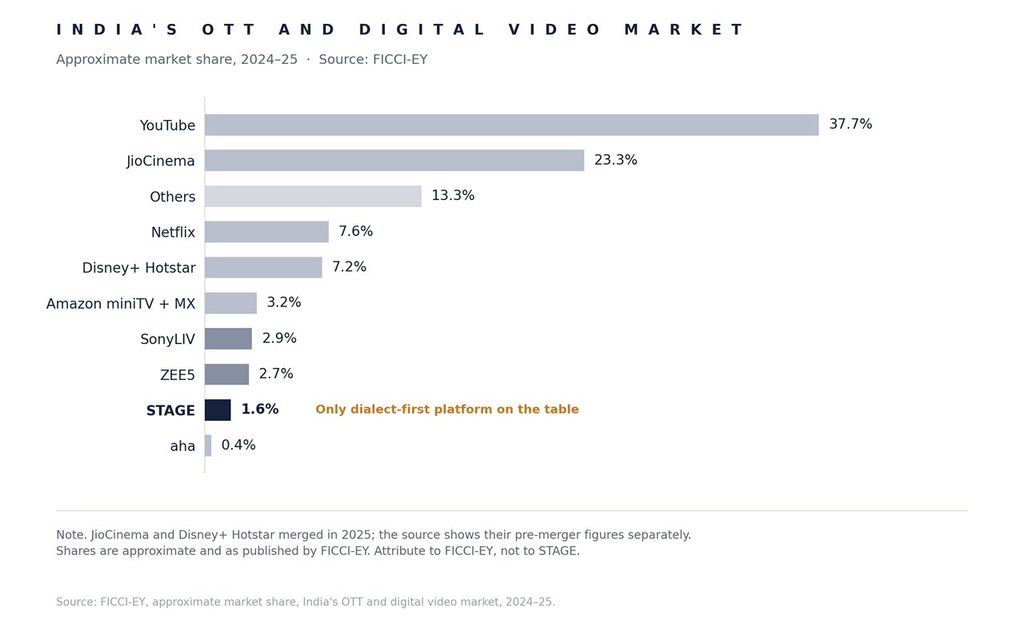
That growth has earned Stage a seat, however modest, at the industry’s big table. FICCI-EY’s estimate of India’s OTT and digital video market for 2024-25 puts the platform at 1.6 per cent share, four times aha’s 0.4 per cent, within 1.1 percentage points of Zee5’s 2.7 per cent and 1.3 points behind SonyLIV’s 2.9 per cent. YouTube (37.7 per cent) and JioCinema (23.3 per cent) still tower over the field, with Netflix on 7.6 per cent and Disney+ Hotstar on 7.2 per cent. Zee5 and SonyLIV both carry the weight of listed broadcast parents and decades of multi-language catalogue behind them; Stage has neither, and is the only dialect-first name on the list.
The tailwind is real. India’s media and entertainment sector grew 9 per cent in 2025 to Rs 2.78 trillion, per FICCI-EY, with digital media crossing Rs 1 trillion in revenue for the first time and becoming the sector’s largest segment. Inside that, digital subscriptions were the standout, up 60 per cent to Rs 163 billion, comfortably outpacing live events (44 per cent), digital advertising (26 per cent) and film (16 per cent). Subscriptions are effectively the only line Stage plays in: they made up 96.9 per cent of revenue in FY24, rising to 99.2 per cent in both FY25 and FY26, and hitting a record 99.7 per cent in the June 2026 quarter. There is no material advertising or sponsorship business to fall back on, and, for now, none needed.
What ought to reassure investors more than the top-line growth is where the growth is coming from. The share of subscription revenue generated by renewing and reactivating customers has climbed in every single reporting period on record: 30.4 per cent in FY24, 56.7 per cent in FY25, 69.7 per cent in FY26 and 80.3 per cent in the June quarter, a 49.9 percentage-point swing. Four-fifths of subscription income is now repeat business rather than freshly acquired. In the June 2026 quarter, total revenue rose 10.5 per cent year on year and subscription revenue 11.4 per cent, with both subscription share and renewal share hitting record highs simultaneously.
The more interesting test, though, is whether a platform built for one dialect can be repeated. Stage now runs six language markets, and the answer, on June 2026’s numbers, looks like yes. Haryanvi, the founding market, recorded 1,66,934 monthly active users and Rajasthani 1,43,903. The four newer markets, Bhojpuri, Gujarati, Marathi and Bengali, added more than 1.24 lakh monthly active users between them. Marathi is the standout: in its first reported quarter it went from roughly 6,400 monthly active users in April 2026 to 38,707 in June, a sixfold jump. Across all six markets, close to 1,99,687 users watched content in June. Engagement is unsurprisingly strongest where the platform has been longest: 53.4 per cent of Haryanvi’s monthly users watched content, against 47.5 per cent in Gujarati and 44.5 per cent in Rajasthani. Bengali, by contrast, is still at incubation stage, and Stage makes no attempt to dress that up as anything else.

The content strategy varies by market, which is sensible given the varying maturity. Haryanvi stays original-led, with 81 per cent of FY26 content minutes added being originals across 65 titles. Rajasthani and Bhojpuri blend original production with acquisition and dubbing, Bhojpuri the most diversified of the lot with 48 originals, 32 acquired titles and 21 dubbed ones. Gujarati, the newest, went dubbing-first, at 87 per cent of opening minutes. Across the four established markets, FY26 added 139 originals, 69 acquired titles and 42 dubbed titles, taking the platform-wide tracked catalogue to roughly 749 hours by February 2026, up 116.5 per cent on April 2023.
Vinay Singhal, Stage’s co-founder and chief executive, frames the opportunity in blunt terms: “India has 22 official languages and more than 1,900+ dialects, and the streaming industry has built for about just five of them. Everyone calls the rest a niche. Half of everything watched on OTT in this country is already in a regional language; that is not a niche, that is the market.” He adds that the goal is “building a connection that has simply been waiting for someone to serve it properly.”
Stage is also leaning on artificial intelligence to make the economics work in languages where conventional production budgets have never stacked up, using AI tools across its production pipeline to compress both cost and cycle time on originals. FICCI-EY, for its part, expects the wider sector to reach Rs 3.3 trillion by 2028, growing at more than 7 per cent annually, with new media accounting for over half of industry revenue by then and regional-language content named as one of the structural forces behind it.
None of this settles the question a listed rival’s shareholders would ask first: what does 6.3 times growth actually amount to in rupees, and will the audit confirm the management numbers as reported. Until Stage discloses absolute revenue, the story remains one of trajectory rather than scale. But trajectory, in a market this fragmented, counts for something. A platform four years into six regional launches, holding renewal rates north of 80 per cent and now visible on the same table as broadcast-backed incumbents, has at minimum proven that dialect streaming is not the niche the rest of the industry assumed it to be.






