eNews
Mumbai’s red alert sends ad budgets and delivery apps scrambling
Storms shut streets and hoardings, then knock the Wi-Fi out from under digital ad plans too

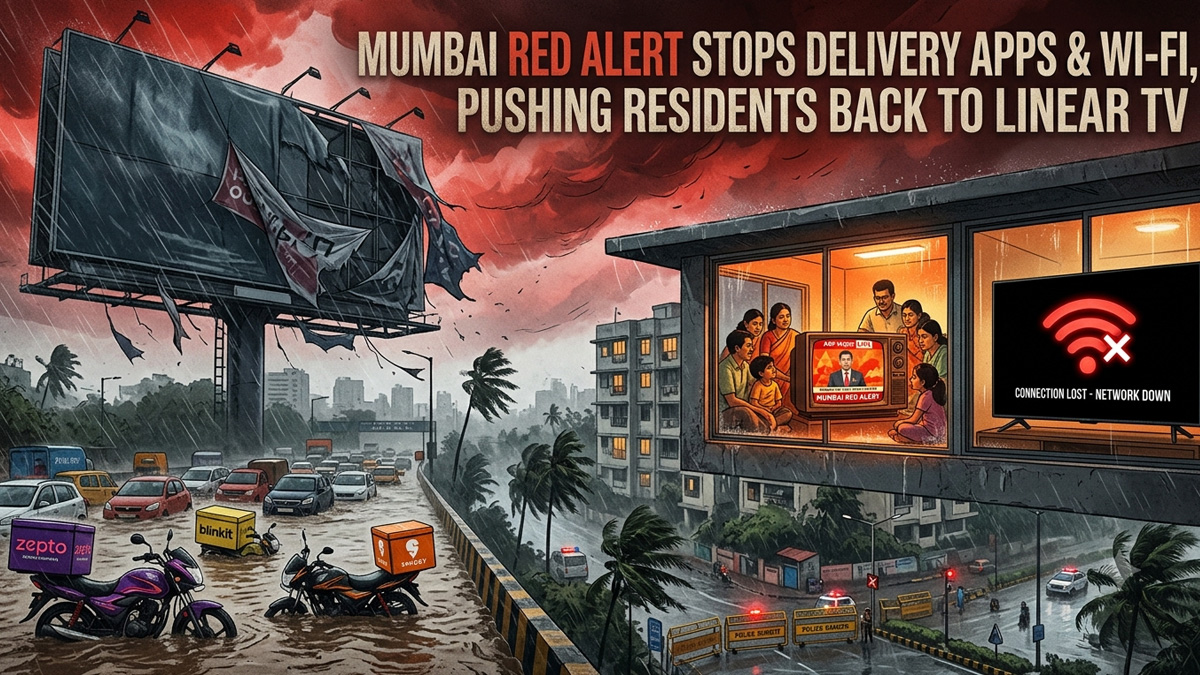
MUMBAI: The financial capital was brought to a virtual standstill as the India Meteorological Department’s red alert for Mumbai, Thane and Raigad took hold, with winds gusting up to 90 kmph and rain lashing down at 200-300 mm. Offices waved staff home, the Mumbai-Pune expressway was shut by landslides, and the city’s economic engine stalled in the flood water. For e-commerce and the advertising trade alike, the deluge forced a scramble few saw coming, and a lesson in just how quickly a well-laid media plan can drown. The alert remains in force, though the worst of the disruption has since begun to ease.
Quick-commerce apps, usually the first beneficiaries of a city stuck indoors, instead hit a wall. Zepto, Blinkit and Instamart, along with Swiggy and Zomato, ran at a mere 40 per cent operational capacity at the peak of the disruption, their once-vaunted ten-minute promise replaced by “services temporarily unavailable” banners or waits stretching past two hours. Waterlogged hubs such as Kurla, Andheri and Vikhroli, the last of which copped 310.6 mm of rain, forced firms to restrict delivery radiuses and prioritise gig-worker safety over gross merchandise value. Traditional e-commerce fared only marginally better, running at 60 per cent, with the expressway closure and stalled rail lines leaving Amazon and Flipkart shipments backlogged by up to 48 hours. Operations have since begun limping back towards normal as waters recede in the worst-hit pockets.
Advertisers, meanwhile, watched their neatly drawn plans get soaked through. Out-of-home hoardings, subject to municipal safety advisories and stripped of passing traffic, saw their cost-per-impression collapse, with the sector effectively stalled and delivering minimal value. The obvious assumption, that a city stuck indoors would simply pour itself into Connected TV and OTT, held true only where the infrastructure allowed it, and for a stretch, it did not.
Widespread power outages and waterlogged underground cables knocked Wi-Fi networks out across large swathes of the suburbs, while mobile towers, running on stressed backup batteries and battered by the same 90 kmph winds, buckled under network congestion and intermittent data drops. For millions of stranded residents, streaming video simply stopped being an option. Instead, viewers reverted to the sturdiest lifeline available: standard linear television, kept alive by cable and satellite links that owe nothing to a router. Regional and public utility channels such as ABP Majha, Zee 24 Taas and TV9 Marathi saw daytime ratings spike as citizens hunted for track-by-track updates on local train disruptions, proving that when the going got tough, the trusty television set still got going.
The digital blackout, in turn, upended programmatic ad strategy overnight. High-budget, geo-targeted digital campaigns aimed at Mumbai IP addresses stalled in the ether, unable to reach screens that had effectively gone dark. Agile FMCG and e-commerce brands read the room fast, pulling back digital spends and pivoting to legacy linear slots on news networks to catch a captive, information-hungry audience instead. The usual prime-time powerhouse, Hindi general entertainment channels, found themselves oddly sidelined, their audience siphoned off by regional news and their entertainment-streaming rivals rendered non-viable by the network blackout. Media planners were left reallocating budgets hour by hour, a stark reminder that in a genuine crisis, it is the sturdiest infrastructure, not the smartest algorithm, that wins the audience.
Brand messaging softened to match the mood. Hard-sell campaigns were quietly shelved in favour of copy tuned to work-from-home routines, monsoon safety and community relief, while high-budget shoots, activations and experiential events around the city were mothballed or pushed back, leaving production houses and event agencies nursing short-term revenue deferrals.
The lesson for the industry remains blunt enough, red alert or not: when the physical city drowns and the digital pipes drown with it, budgets that cannot move at the speed of the weather, and the infrastructure, get left stranded on the wrong side of the flood line. With connectivity now stabilising, media planners face a fresh challenge: unwinding the emergency playbook just as fast as they built it.