ITV News
India’s e-commerce set to hit $250 billion by 2030
Google-Deloitte report highlights shift to AI-powered, creator-driven shopping.


MUMBAI: India’s online shopping spree is about to go from impressive to unstoppable because when 150 million new digital shoppers join the party and Gen Z starts calling the shots, even the most ambitious targets start looking modest. According to the new Google and Deloitte report titled The $250 Billion Commerce Frontier, India’s e-commerce market is projected to nearly triple from $90 billion today to $250 billion by 2030. This explosive growth will be driven by four key forces Inspired, Intelligent, Instant, and Immersive which together are expected to add $100 billion to the sector.
The report highlights a major shift from basic infrastructure access to “unified value”, where the traditional linear shopping funnel gives way to an always-on cycle of discovery, validation, and instant gratification. A 220-million-strong Gen Z cohort is set to command 45 per cent of online spend, pushing brands towards AI-powered, personalised experiences.
Google India, managing director for connected consumer commerce Roma Datta Chobey said, “Consumers today demand experiences inspired by storytelling, powered by AI and immersive technologies, and anchored by instant fulfilment.” She highlighted Google’s tools such as virtual try-on, AI Mode in Search, and the Gemini app as key enablers in this evolution.

Deloitte, partner & consumer industry leader – South Asia Anand Ramanathan, at noted that India’s e-commerce is entering a phase of “algorithmic intimacy”, where demand is not just predicted but synthesised in real time through generative commerce and curation-as-a-service.
Key forces shaping the future
- Creators as commerce engines: By 2030, creators are expected to influence 30 plus of total retail spend, with one in ten online purchases coming directly from creator storefronts. Live Commerce alone is projected to become an $8 billion sector, particularly strong in Tier 2 plus markets where creators will onboard 60 million first-time buyers. YouTube has strengthened this trend by onboarding Tira (Reliance Retail’s beauty platform) and expanding its Shopping Affiliate Program.
- Quick commerce goes mainstream: The sector is maturing into a $50 billion powerhouse, with its shopper base doubling to 70 million. Tier 2 plus cities will drive 30 plus of the market, while non-food categories like Beauty, Fashion and Electronics will account for 45 plus of spend. Hybrid models integrating offline inventory could unlock an additional $20 billion opportunity.
- AI as profitability booster: Artificial intelligence is expected to deliver a 30–35 per cent boost in retail profitability through hyper-personalisation and operational efficiency. Google’s latest updates in Gemini, AI Mode, and Circle to Search aim to make shopping more conversational and seamless.
- Immersive tech drives uplift: 89 per cent of shoppers want a fluid journey with a single cart across online and offline. AR and virtual try-on features are already proving powerful, with 1 in 3 Indian shoppers preferring virtual trials and half of them significantly increasing their spend.
The report, produced in collaboration with Kantar, offers a clear roadmap for brands, platforms and retailers to thrive in India’s next phase of digital commerce, one defined by intelligence, speed, creativity and immersion.
From scrolling to buying in seconds, India’s shoppers are ready for the future. The only question now is how fast brands can keep up with the pace.







ITV News
Instamart sees 45x surge in Akshaya Tritiya demand
Gold jumps 49x, silver 24x as quick commerce drives festive buying.
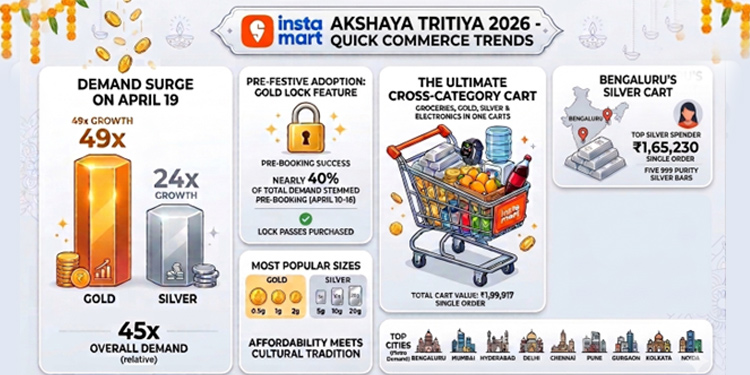
MUMBAI: From adding to cart to adding to culture, festive gold buying just got a same-day delivery upgrade. Instamart reported a sharp spike in demand on Akshaya Tritiya, with overall orders surging 45x on April 19 as shoppers turned to quick commerce for everything from gold coins to groceries. The biggest sparkle came from gold, which saw a 49x jump in demand, while silver followed with a 24x increase. Smaller denominations dominated gold purchases, with 1g, 2g and 0.5g coins emerging as the most popular picks suggesting that affordability continues to shape festive buying as much as tradition.
Silver, however, played a different game. Larger ticket sizes led the charge, with 10g, 5g and 20g bars topping the charts. In one standout order from Bengaluru, a single shopper added Rs 1.65 lakh worth of silver bars to their cart in one go, underlining how the metal is increasingly being seen as both a gifting and investment option.
Adding a strategic twist to the gold rush, Instamart introduced a Price Lock feature that allowed users to secure pre-festive gold rates between April 10 and April 16, with redemption on April 19 at the lower of the locked or prevailing market price. Nearly 40 per cent of total demand came from these pre-booked orders, indicating a growing appetite for price-sensitive, tech-enabled buying.
Perhaps the most telling trend, however, lay in what else went into the cart. The largest order of the weekend worth Rs 1,99,917 combined Rs 1.65 lakh in silver bars and Rs 31,800 in gold coins with everyday items such as soft drinks, ice cubes, Alphonso mangoes, a water dispenser and even a smartwatch. The modern festive basket, it seems, is no longer confined to jewellery counters.
Metro cities led the charge, with Bengaluru, Mumbai, Hyderabad, Delhi, Chennai, Pune, Gurgaon, Kolkata and Noida driving the bulk of demand highlighting how urban India is increasingly blending tradition with convenience.
As quick commerce platforms continue to expand beyond essentials, Akshaya Tritiya offered a glimpse of the future: where buying gold is no longer a planned outing, but just another tap away.