News Headline
“Non-fiction is expensive, hence need to strengthen fiction”: Siddharth Anand Kumar


MUMBAI: Vidya Balan’s famous line about entertainment sells, stay true to the television business as well.
With new channels launched and new genres explored every now and then, the production houses have a lot on their platter. One such production house, Colosceum, known for its non-fictional properties like Roadies, Splitsvilla recently got on board Siddharth Anand Kumar as scripted content head to strengthen its overall approach.

A graduate in filmmaking, he has worked as an assistant to Mira Nair during the making of Kamasutra (1995), as DOP and editor for Bobby Bedi during the production of the TV series Rajdhani (2000), and as the executive producer for Shekhar Kapur’s company Digital Talkies during which he oversaw the production of two feature films and the country’s first International Digital Film Festival (2001).
He has directed two films: Let’s Enjoy (2004), a film about a Delhi farmhouse party, and Semshook (2010), a coming of age story set in the Tibetan exile community. And his TV projects include Seven and Khotey Sikkey by Yash Raj Films on Sony and Mahabharat by Swastik Pictures on Star Plus.
“We have a partnership with Colosceum. And our aim is to bring in some really interesting new content into the Indian television which is currently happening and we want to be a part of it,” says Kumar while elaborating on his role. “In the industry there is a position of content director and director and I will be mixing both these roles. It is also something which the channels want and are eager to do because it is the director who makes the show. And sometimes we have creative director who doesn’t engage in day to day procedure of the show or while communicating with the broadcasters. We want to bridge that gap.”
He along with the Colosceum team is currently busy conceiving and pitching ideas to broadcasters, which will then be taken forward if the broadcaster shows interest.
The production house is known for its seasonal shows, but with this hire it wants to strengthen its fiction side as well. Kumar goes on to explain why. “Colosceum had non-fiction bend but if you look at the trend, all the big production houses whether they are Endemol or Fremantle, you will see a small shift little away from non-fiction because non-fiction costs a lot. And the numbers that you get are pretty much the same as a hit fiction property. So, everyone understands that the return of investment is higher on fiction. Producers who have had a very strong non-fiction background like Colosceum need to partner with strong fiction heads to tell the broadcasters ‘look we have the right team in place’.”
Furthermore, he believes channels are now moving towards fiction. Stating the example of how Bindass, which once used to air shows like Big Switch and Dadagiri, today has fiction shows. Similarly Channel V and MTV have now become youth general entertainment channels (GECs).
Moreover, even GECs which offered their viewers two to three non-fictional properties over weekend, now only have one such property.
“Take Colors for instance, apart from Jhalak Dikhla Ja it doesn’t air any other non-fictional property on the weekend. I won’t take Comedy Nights with Kapil to be one as it is scripted. The trend is indicating that every channel is putting their money into one non-fiction show because they are expensive and rest on fiction,” he says and adds, “Right now we are in the phase when there is a greater demand for fiction than non-fiction. At some time, the circle might change again. So, this is a good time to generate some quality fiction content and strengthen it so we are able to serve the broadcaster in both the genres.”
Kumar believes that as audiences mature, the content will change as well and hence, channels are moving towards younger content as well as dealing with social issues apart from the regular saas-bahu dramas. Another aspect which is also a main reason for this shift in content today is the demand from the advertisers. “The consumer categories which are very hot at the moment are smartphones, cars and e-commerce, and they need to talk to a younger-skewed audience not only in metros but also in tier I and II cities where there is high aspirational power. Youth has more spending power because as one grows older, the commitments/priorities change. So advertisers need to talk to them and hence broadcasters need to create content for this audience.”
One needs to just turn on the TV to see who is advertising so if it’s a Karbonn mobile it doesn’t want to advertise on Saath Nibana Saathiya but need a show like Airlines or Shastri Sisters.
In the coming years, he proposes that as more and more people start consuming content on digital, production houses might have to start making specific content for that medium and also learn how to monetise it well. As media proliferates there is going to be more fragmentation and niche programming.
Hence, Colosceum will focus on creating tailor-made shows for broadcasters based on what that broadcaster wants in its programming lineup. Currently, the team has a lot of ideas on the platter and will soon approach broadcasters with the innovative and interesting ideas.
In his 12 years career, Kumar says that even today “we don’t know what the audience wants.” There is still a lot of guess work even though there are various research agencies doing a lot of footwork. So when it comes to talking to the audience and seducing them with the work there is still a bit of hit and miss. “We usually have the tendency of coping what becomes a hit, but it won’t serve our purpose as we will start creating same content that will create fatigue amongst audiences.”
“We need to provide a varied content to audience which is also dynamic. So that we can learn what the audience wants,” he concludes.





NEW DELHI: Hamdard Laboratories gathered a cross-section of India’s achievers in New Delhi on Friday, handing out the Hakeem Abdul Hameed Excellence Awards to figures who have left their mark across healthcare, education, sport, public service and the arts.
The ceremony, attended by minister of state for defence Sanjay Seth and senior officials from the ministry of Ayush, celebrated individuals whose work blends professional success with a sense of public purpose. It was as much a roll call of achievement as it was a reminder that influence is not measured only in profits or podiums, but in people reached and lives improved.
Among the headline awardees was Alakh Pandey, founder and chief executive of PhysicsWallah, recognised for turning affordable digital learning into a mass movement. On the sporting front, Arjuna Awardee and kabaddi player Sakshi Puniya was honoured for her contribution to the game and for pushing women’s participation onto bigger stages.
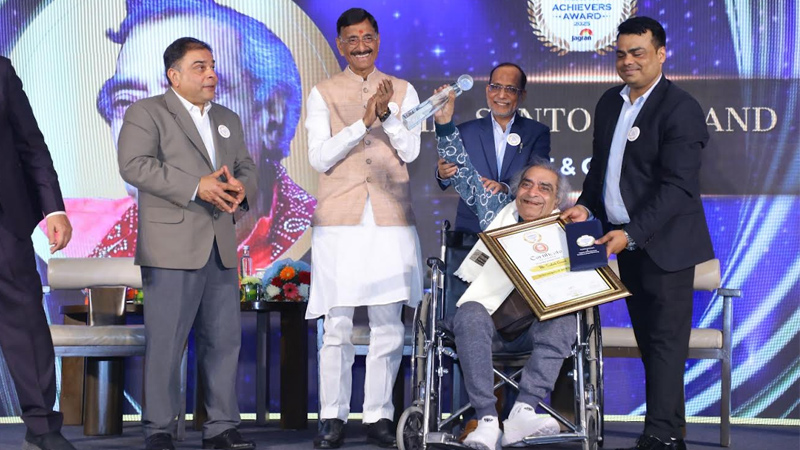
The cultural spotlight fell on veteran lyricist and poet Santosh Anand, whose songs have echoed across generations of Hindi cinema. At 97, Anand accepted the honour with characteristic humility, reflecting on a life shaped by perseverance and hope.
Healthcare honours spanned both modern and traditional systems. Manoj N. Nesari was recognised for strengthening Ayurveda’s place in national and global health frameworks. Padma shri Mohammed Abdul Waheed was honoured for his research-backed work in Unani medicine, while padma shri Mohsin Wali received recognition for his long-standing contribution to patient-centred care.
Education and social development also featured prominently. Padma shri Zahir Ishaq Kazi was honoured for decades of work in education, while former Meghalaya superintendent of Police T. C. Chacko was recognised for public service. Goonj founder Anshu Gupta received an award for his dignity-centred rural development initiatives, and the Hunar Shakti Foundation was honoured for empowering women and young girls through skill development.
The Lifetime Achievement Award went to former IAS officer Shailaja Chandra for her long career in public healthcare and governance, particularly in the traditional systems under Ayush.
Speaking at the event, Hamdard chairman Abdul Majeed said the awards were a tribute to those who combine excellence with empathy. “These awardees reflect Hakeem Sahib’s belief that healthcare, education and public service must ultimately serve humanity,” he said.
Minister Seth struck a forward-looking note, saying India’s young population gives the country a unique opportunity to become a global destination for learning, health and wellness by 2047.
The ceremony also featured the trailer launch of Unani Ki Kahaani, an upcoming documentary starring actor Jim Sarbh, set to premiere on Discovery on 11 February.
Instituted in memory of Unani scholar and educationist Hakeem Abdul Hameed, the awards have grown into a national platform that celebrates those building a more inclusive and resilient India. For one evening at least, the spotlight was not just on success, but on service with substance.