Budget
Budget 2015: Futuristic and progressive, feels media industry

MUMBAI: If Suresh Prabhu’s Rail Budget spelt out a pro – poor stanza, then Arun Jaitley has recited a pro-poor poetry while presenting the Union Budget.
With burdens of expectations and aspirations, the Finance Minister started his presentation at 11 am on 28 February. As it is said ‘the morning shows the day,’ his initial sentences enlightened poor of the country. With pension and health insurance schemes, the government successfully managed to add smiles to the below middle class society. Jaitley’s pro-poor, pro-growth and pro-reform mantra followed throughout the budget. Sanitization, minority education, preservation of heritage sites, job creation and empowerment of youth were given supreme priority.

Viacom18 Media group CEO and CII National Committee on Media & Entertainment chairman Sudhanshu Vats said, “Two words sum up the essence of Budget 2015: balance and clarity. Finance Minister Arun Jaitley walked the tightrope by staying away from big bang announcements that might have strained the fiscal position, while taking substantial steps on matters of tax, social security and public investment (especially in Infrastructure). On the reduction in corporate tax rates to 25 per cent, the 4-year implementation roadmap is a welcome addition. This is the clarity that the corporate sector needs so far as tax policy is concerned. While personal income tax slabs remain unchanged, higher exemptions are targeted towards savings and would add to retirement income in taxpayers’ wallets. ‘Wallets’ too will don a different connotation given the FM’s vision for a cashless society. The clarity on corporate tax road map is a welcome development for investments in the Indian M&E sector.”
He further added, “The reduction in withholding tax rates (to 10 per cent) on royalty and FTS payments to non-residents has finally been granted. The increase in service tax is probably to bring the rate closer to the rates expected under the GST regime. In that context, the step is the proverbial bitter pill for our industry. I must compliment the FM for his announcement of social security schemes for the vulnerable sections of society as a vital cornerstone towards inclusive growth and development. All in all, this is a ‘Make in India’ budget that will truly ‘Make India’.”
ZEEL CEO and MD Punit Goenka congratulating Jaitley said, “Indeed a futuristic and growth oriented Super Budget presented by Arun Jaitley! The Budget has certainly addressed the overall tax concerns and has portrayed a positive picture for the investors! It is certainly a Budget to remember for the Common Man, since it has remarkably addressed all the key aspects like housing, jobs & education! Congratulations Arun Jaitley for wonderfully addressing the nation’s concerns through the Budget 2015 & for setting some key goals for 2022!”
Reduction of corporate tax, increase in service tax and abolition of wealth tax with a surcharge of two per cent for income over Rs 1 crore was the eyebrow raiser for the corporate industry. But the line that will be music to many industrialists was, “abhi permission lene me hi saalo beet jaate hain, project shuru bhi nahi hota” (it takes years to get the necessary permissions and the projects don’t take off), which signifies minister’s inclination towards establishing a business friendly environment. He also spoke about forming a pre existing regulatory mechanism to ensure fast and transparent business market.
According to Reliance Broadcast Network CEO Tarun Katial, the budget is positive, realistic and progressive in nature. “The overall budget seems to be well thought of with a holistic approach and some key announcements for the service industry. The proposed reduction in corporate tax over the next four years is encouraging as it will result in higher investments, growth and more jobs creation. The move to increase the service tax however will put smaller advertisers under pressure and hamper advertising spends. The move on CSR is good and radio can be used effectively as a catalyst for social transformation in initiatives like Swachh Bharat, since radio can reach to the remotest of the corners where no other medium does because of literacy and cost issues, especially so with phase III and deeper reach. Overall a very good budget and I congratulate the Government for presenting us with a good futuristic budget.”
The level of expectations and aspirations were visible in share market too. Both Sensex and Nifty soared before Jaitley’s presentation. The market was waiting for some big announcements and reduction of corporate tax was one of them.
The major outlines of the budget include:
Policy Reforms
· Create a universal social security system for all Indians
· Commodities regulator to be marched with SEBI
· New bankruptcy code in 2015/16
· Promise to amend the RBI act this year and provide for a monetary policy committee
· To set up public debt management agency
· To raise visa-on-arrival facility to 150 countries from 43
Taxation
· To implement goods and services tax by April 2016
· To increase service tax to 14 per cent
· Reduction in corporate tax to 25 per cent from 30 over next four years
· Wealth tax to be abolished, but a surcharge of two per cent for ‘Super Rich’ earning over Rs 1 crore
· Plans to introduce direct tax regime that is internationally competitive on rates without exemptions
Fiscal Deficit
· Fiscal deficit seen at 3.9 per cent of GDP in 2015/16
· Challenge of achieving fiscal target of 4.1 per cent of GDP
· Commitment to meet medium term fiscal deficit target of three per cent of GDP
· Current account deficit below 1.3 per cent of GDP
· Need to keep fiscal discipline in mind despite need for higher investment
Growth
· GDP growth seen at between 8 – 8.5 per cent
· Aiming double digit durable growth rate, achievable soon
Inflation
· Consumer inflation to remain close to five per cent by March, opening room for more monetary policy easing
· Monetary policy framework agreement with the RBI clearly states objective of keeping inflation below sic per cent
Investment
· Propose to do away with different types of foreign investment and replace them with composite caps
· To allow foreign investment in alternative investment funds





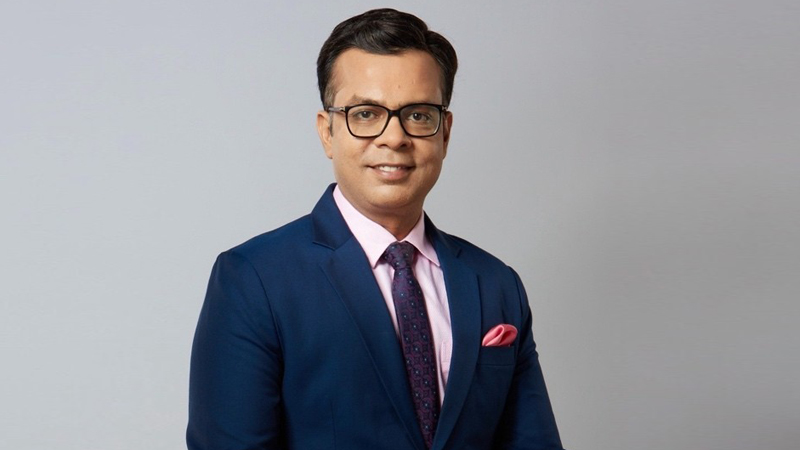
MUMBAI: Anuj Singhal, managing editor at CNBC- AWAAZ and CNBC BAJAR, operates at the sharp end of India’s business news ecosystem. With over two decades in business journalism, he has earned credibility for decoding policy, markets and macro trends for millions of Hindi-speaking investors. Equal parts newsroom leader and market analyst, he shapes editorial direction while anchoring flagship shows that break down the economy, politics and corporate India in real time.
Known for cutting through jargon and hype, Singhal blends data, discipline and clarity — a mix that has made him one of the most trusted voices in Hindi business news.
In this interaction, he discusses the Union Budget, trade deals, newsroom strategy and what truly moves markets and ratings.
• What was the single most market-moving announcement in this Budget, and why?
The most market-moving element was the clear commitment to fiscal consolidation without compromising capex. The glide path on fiscal deficit reassured bond markets and foreign investors, while sustained public investment kept growth expectations intact. That balance removed a big overhang for both equities and debt.
• Do you see this Budget as growth-oriented, fiscally cautious, or politically calibrated?
This Budget is growth-led but fiscally disciplined. It avoids overt populism, stays within macro guardrails, and prioritises medium-term competitiveness over short-term optics. Politically, it is restrained; economically, it is deliberate. The message is clear: stability over spectacle.
• How is CNBC-AWAAZ programming different, especially in decoding trade deal impact?
CNBC-AWAAZ goes beyond headline reaction. We translate policy into portfolio impact — sector by sector, stock by stock.
On trade agreements, our focus is on:
-Earnings visibility
-Export competitiveness
-Currency implications
-Margin sustainability
We don’t treat trade deals as political milestones. We decode them as profit-and-loss events for corporate India and map them to FY earnings trajectories.
• Which sectors look like clear winners and laggards over the next 12–18 months?
The next 12–18 months favour sectors aligned with structural spending and supply-side strengthening.
– Clear beneficiaries:
Capital goods and infrastructure
Manufacturing linked to export chains and PLI ecosystems
Power, defence, and logistics
– Relative laggards:
Consumption segments dependent on immediate demand revival
Businesses facing margin pressure from global volatility or pricing power erosion
This is not a momentum-driven market environment. It is execution-driven. Balance-sheet strength and order visibility will matter more than narrative.
• One headline to sum up this Budget 2026 for India Inc?
“Steady Hands, Long-Term Vision: A Budget That Rewards Discipline Over Drama”.
• What editorial filters do you apply before calling something ‘market-positive’ or ‘negative’?
We apply three structured filters:
– First: Earnings translation — does this materially change earnings visibility or cash flow outlook?
– Second: Time horizon — is the impact immediate, cyclical, or structural?
– Third: Valuation context — good news priced in or not.
If a policy doesn’t move earnings or risk perception, we don’t oversell it.
• How has business news consumption changed around big policy events?**
There has been a clear behavioural shift. They’re less interested in what was said, more in what it means for their money. There’s also a clear shift toward second-screen consumption, with digital platforms complementing live TV. The audience seeks sharper accountability. Viewers no longer accept broad optimism or pessimism — they want frameworks, numbers, and sector mapping.
• CNBC-AWAAZ decisively outperformed on Budget Day. What editorial and distribution choices mattered most?
Three deliberate strategic choices:
– Preparation depth:
We build scenarios months in advance — deficit ranges, sectoral incentives, tax calibrations — so we’re ready with analysis the moment numbers are announced.
– Language of impact:
We translate macro policy into investor-friendly Hindi without diluting complexity. That bridges accessibility and sophistication.
– Integrated distribution:
Television, YouTube, and digital platforms operate as one editorial grid, not parallel silos. This ensures continuity of narrative.We stayed analytical while others stayed reactive.
• How different is your YouTube audience from your TV audience?
The behavioural differences are subtle but important. TV audiences prioritise authority, structured debate, and context. YouTube audiences want speed, clarity, and actionable insights — often sharper, sometimes more opinionated. However, both share one expectation: accuracy. The format evolves; the trust benchmark does not.
• How do you retain viewers after the budget speech ends?
By shifting from announcements to implications.Retention comes from shifting the narrative from announcement to implication. We break down sectoral breakouts, stock-level impact, and what to do next. The speech is just the trigger; analysis is the destination.
• Is Budget Day your biggest traffic day?
It is one of the biggest — but more importantly, it is among the deepest in engagement. Viewers spend longer durations, revisit segments, and seek follow-up programming. That indicates behavioural trust, not just traffic.
• What’s the first thing you personally track on Budget Day — the speech or the markets?
The markets. They’re the fastest truth-teller. The speech explains intent; markets reveal interpretation.
• Your personal Budget-day ritual?
Early morning prep, minimal distractions, and once the speech begins, complete immersion. For me, Budget Day is less about reaction and more about reading between the lines.
• What drove your Budget-day ratings dominance, and how are Budget and trade deals shaping markets now?
Our dominance came from credibility, consistency, and clarity.
As for markets, both the Budget and recent trade deals are reinforcing a narrative of policy stability and global integration, which supports valuations even amid global volatility.
For Singhal, the market is the final judge. Policies can promise and speeches can persuade, but prices reveal what investors truly believe. As India’s investor class grows more informed and more demanding, business journalism is shifting from commentary to calibration. The premium is on clarity, context and credibility. In a landscape flooded with noise, the real edge lies in interpretation. In the end, the markets listen to numbers, not narratives , and Singhal’s craft is helping viewers tell the difference.