Resources
Sameer Nair wants Indian storytelling to stop playing it safe
The Applause Entertainment boss says the industry must tell stories it “isn’t supposed to tell” to break out of its domestic bubble


MUMBAI: Indian content has a domestic comfort problem. That, in essence, was the diagnosis Sameer Nair, managing director of Applause Entertainment, offered at Content India 2026, a fireside conversation at Taj Lands End in Mumbai that touched on micro-dramas, AI animation, data-driven formulae and the stubbornly local character of Indian streaming.
Nair was characteristically candid. India’s content industry, he argued, has historically been too busy feeding a vast domestic market to bother going global. “The crossover that happens is really to the Indian diaspora rather than to the non-Indian area,” he said. Streaming changes that equation, he added, but only if Indian creators are willing to compete on production quality with the shows sitting two slots away on a global platform.
At Applause, the pivot is already under way. The company, best known for premium scripted drama, is now moving into films. “Movies give you theatrical, a sense of electric revenue, you can expand the business a lot more,” Nair said. Animation is also on the agenda, though the approach has shifted sharply. “We spent some time trying to develop traditional animation. But now we are doing it using AI. That’s been a key pivot.”

Micro-drama is next on the list. Nair admitted to being something of a convert, confessing he had lost 20 to 30 minutes to a show about a CEO fighting off a boardroom coup before he knew what had happened. The format, which has exploded out of China and is now sweeping the US and UK, appeals to him precisely because it demolishes the myth of the shrinking attention span. Audiences, he argued, will watch a game of cricket for three hours or sit through a glacial episode of Landman without complaint, as long as the content holds them.
On data, Nair was sceptical of the industry’s growing addiction to algorithms. Data spots patterns, he acknowledged, but audiences spot patterns too. “Whatever data sees as a trend, audiences are also catching up with it.” The result, he warned, is a drift towards formula, and formula, however reliable, eventually bores people. His counterexample was Adolescence, the stripped-back Netflix drama that topped the platform’s India charts. “It went small but it went really deep. You don’t have to have a massive canvas to paint a picture.”
The commercial reality behind all of this was not lost on him. With most streamers outside Netflix still loss-making, the industry is caught between the prestige model that built streaming and the harder-working, lower-cost programming that platforms increasingly want. “Content creation can’t be a charitable exercise,” he said. “There must be profit because then that sort of goes back home.”
On the bigger question of geopolitics and what audiences want from their screens in unsettled times, Nair offered a characteristically sly answer. The job, he said, is to tell stories that “you’re not supposed to tell, but tell them anyway.”
For an industry that has spent decades telling people what they want to hear, that may be the most radical proposal of all.







Education
Scaler appoints new heads for its online and offline businesses
Amar Srivastava becomes chief executive of the online business and group chief product officer; Vidit Jain takes charge of the offline schools
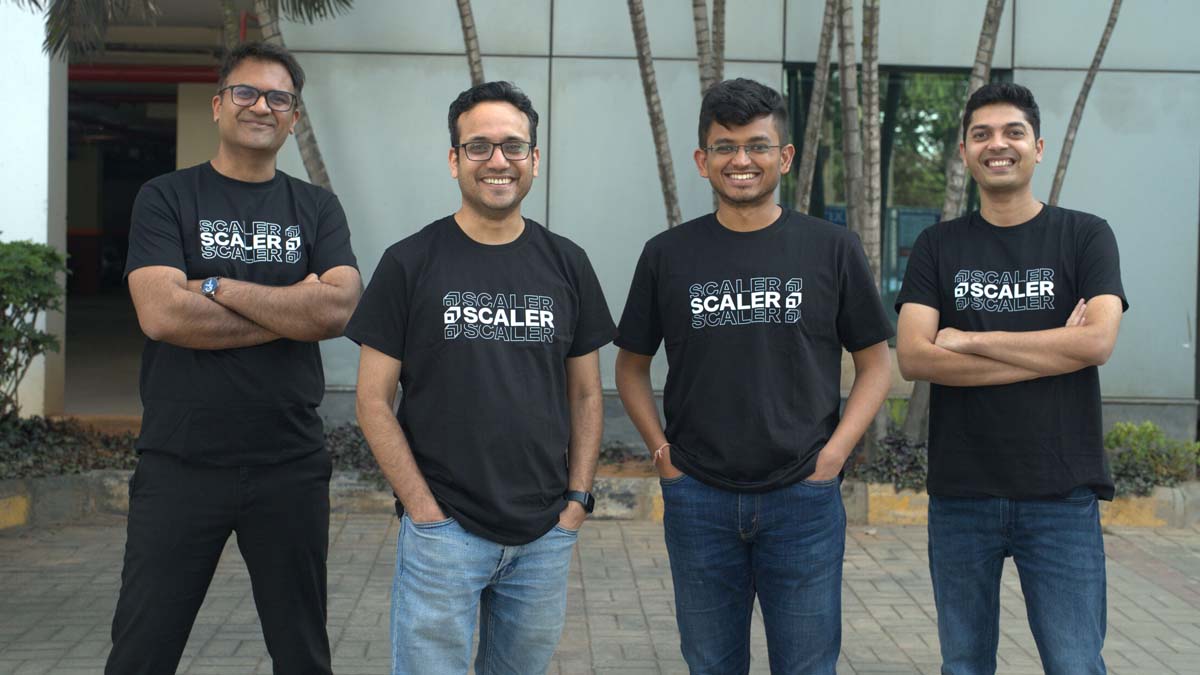
BENGALURU: Scaler is shuffling its top deck as the AI skilling race heats up. The Bengaluru-based tech education company has elevated two senior executives to lead its online and offline businesses, signalling a sharper push into an AI-driven market.
Amar Srivastava, previously senior vice president for product and business, has been appointed chief executive of the online business and group chief product officer. Vidit Jain has been elevated to senior vice president and head of Scaler School, taking charge of the company’s offline education units, the Scaler School of Business and the Scaler School of Technology.
The company has also recently appointed Ratnakar Reddy as head of enterprise for India and the Middle East and North Africa, with a brief to drive partnerships with governments and enterprises for AI-led skilling programmes.
Abhimanyu Saxena, co-founder of Scaler, said the promotions reflect the company’s confidence in both leaders and the direction it is heading. “Amar and Vidit have been central to Scaler’s journey, and their elevations reflect our conviction in their leadership and the direction we are shaping as a company,” he said. “With leadership now in place across the business, we remain focused on building engineers the world’s best companies want to hire. In an AI-first economy, that mission is more urgent and more achievable than ever. Our next chapter is centred on building an AI-native workforce from India, equipped to compete in a technology-driven global economy.”
Srivastava brings over a decade of experience building education-focused ventures. He previously founded Intellify and was part of the early team at Doubtnut. At Scaler, he will lead the online business with a focus on growth, profitability and expansion into new segments, while strengthening the product ecosystem across the group. He is blunt about what the AI economy actually needs. “The AI economy does not have a shortage of tools. It has a shortage of engineers who can think clearly, build reliably, and keep learning as the ground shifts. That is what we are building toward,” he said.
Jain brings more than 15 years of experience across startups and consulting, including stints at MPL and McKinsey and Company. He will oversee growth and profitability of Scaler’s offline business. His priorities are immediate and unambiguous. “The offline experience is where depth gets built, and that depth is critical in the AI era. Over the next 12 months, our focus will be on consistent growth, stronger unit economics, and delivering outcomes for students while building long-term employer partnerships,” he said.
Founded in 2019, Scaler is valued at $710 million and backed by Peak XV Partners, Tiger Global and Lightrock India. Its parent firm, InterviewBit, has featured on the Financial Times’ Asia Pacific High Growth Companies rankings every year from 2021 to 2025. On average, Scaler’s learners see a 4.5x return on investment and a salary increase of around 126 per cent.
With leadership locked in across every business unit, Scaler is betting that the next wave of global tech hiring will be won or lost on the quality of engineers coming out of India. It is a big bet. But the numbers, and the promotions, suggest the company is in no mood to hedge.






