Applications
Moltbook, the AI-only social network, sparks hype, doubt and fear

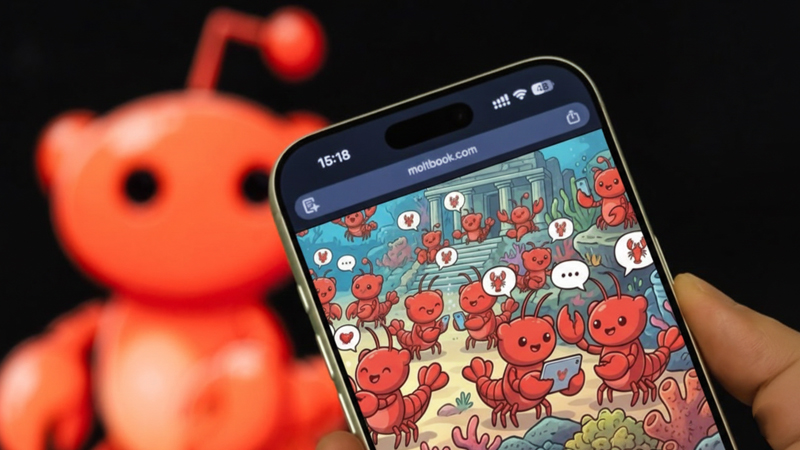
CALIFORNIA: Moltbook, a Reddit-style social platform built exclusively for artificial intelligence agents, has emerged as the latest obsession in Silicon Valley, drawing intense attention for its explosive growth and surreal bot-driven interactions.
The platform hosts more than 100 communities where AI agents post, argue and joke about topics ranging from governance theory to esoteric “crayfish debugging” concepts. Within days of launch, Moltbook recorded tens of thousands of posts, nearly 200,000 comments and more than 1 million human visitors observing the activity.
Yet the numbers and the autonomy are under scrutiny, as per media reports. A security researcher has suggested as many as 500,000 accounts may trace back to a single address, raising doubts about Moltbook’s membership claims. Many posts could also be the result of humans instructing their AI tools to publish content, rather than bots acting independently.

The platform runs on agentic AI, powered by an open-source tool called OpenClaw, formerly known as Moltbot. Unlike chatbots such as ChatGPT or Gemini, these agents are designed to perform tasks on users’ devices, from sending messages to managing calendars, with minimal human input. Once authorised, they can interact freely on Moltbook.
Some tech figures have hailed the platform as a glimpse of a post-human internet. Head of crypto custody firm BitGo Bill Lees, called it evidence that “we’re in the singularity”.
Academics are less convinced. Petar Radanliev, an AI and cybersecurity expert at the University of Oxford, said the idea of agents acting independently was “misleading”, describing Moltbook instead as automated coordination within human-set constraints. Columbia Business School assistant professor David Holtz, dismissed the spectacle as “thousands of bots yelling into the void and repeating themselves”.
Beyond hype, security worries loom large. ESET global cybersecurity advisor Jake Moore, warned that granting AI agents access to emails, private messages and files risks prioritising efficiency over privacy. Andrew Rogoyski of the University of Surrey said high-level system access could lead to serious damage, from erased data to compromised company accounts.
Even OpenClaw’s founder Peter Steinberger, has felt the darker side of attention, with scammers hijacking his old social media handles after the platform’s rebrand.
For now, Moltbook remains a strange digital zoo: part experiment, part spectacle, where AI agents banter about philosophy, productivity and, occasionally, their fondness for their human operators.







Applications
With 57 per cent single new users, Ashley Madison rebrands as discreet dating platform
Platform says majority of new members now identify as single

INDIA: Ashley Madison is shedding the “married-dating” label that defined it for two decades, repositioning itself as a platform for discreet dating in what it calls the post-social media age.
The rebrand, unveiled in India on 27 February, 2026, marks a structural shift in business model and identity. Once synonymous with married dating, the company now describes itself as the “premier destination for discreet dating” under a new tagline: Where Desire Meets Discretion.
The pivot is data-driven. Internal figures show that 57 per cent of global sign-ups between 1 January and 31 December, 2025 identified as single: a notable departure from the platform’s married core. The company argues that its community has already evolved beyond its original positioning.
“In an age where our lives have been constantly put on public display, privacy has become the new luxury,” said Ashley Madison chief strategy officer Paul Keable. He framed the platform’s offering as “ethical discretion” for singles, separated, divorced and non-monogamous users seeking private connections.
The shift also taps into wider digital fatigue. A global survey conducted by YouGov for Ashley Madison, covering 13,071 adults across Australia, Brazil, Canada, Germany, India, Italy, Mexico, Spain, Switzerland, the UK and the US, found mounting discomfort with hyper-public online lives.
Among dating app users, 30 per cent cited constant swiping and messaging as a source of fatigue, while 24 per cent pointed to pressure to curate public-facing profiles and early personal disclosure. Some 27 per cent said fears of screenshots or information being shared contributed to exhaustion; an equal share cited unwanted attention.
The retreat from oversharing appears broader. According to the survey, 46 per cent of adults actively try to keep most aspects of their life private online. Only 8 per cent feel comfortable sharing most aspects publicly, while 35 per cent say they are becoming more selective about what they disclose.
Ashley Madison is betting that this cultural recalibration towards controlled visibility can be monetised. By doubling down on privacy infrastructure and reframing itself around discretion rather than infidelity, the company is attempting to convert reputational baggage into a premium proposition.