GECs
Mahabharat Redux on Star Plus

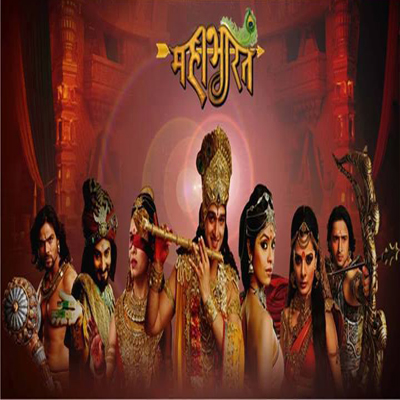
NEW DELHI: The last time television audiences were treated to a telling of the Hindu epic Mahabharat was BR Chopra’s hit serial of the same name, which aired on DD National between 1988 and 1990.
More than two decades later, Star Plus is bringing back to Indian drawing rooms the mythological battle between good and evil, albeit with a contemporary twist.
Starting 16 September, the new age 128-episode Mahabharat will premiere on the channel, to be telecast Monday to Friday 8:30 pm onward.

 So what’s in it for today’s viewers? For starters, unlike in the earlier version, Lord Krishna comes to your homes not as the Sutradhar/preacher but as someone who throws questions at the audience leaving them to ponder over.
Excited about the series, Star Plus senior VP, marketing head Nikhil Madhok says: “The Mahabharat is a very important part of our culture and history, and we felt that this is what Star Plus should bring to the country. While other great epics like the Ramayan are simpler to narrate, the Mahabharat is more complex. Also, the points of view differ and depending on which point of view you take, one lands up presenting the story differently.”
Bringing us to other differences in this avatar of Mahabharat – Not only is it presented from Lord Krishna’s point of view, other characters too are presented differently in the promotional campaign. “For example, Shakuni, who has always been seen as an instigator, this time round, will demonstrate his point of view. Our concept is to understand his actions. He is a possessive brother, who is concerned about his sister, who has been forcefully married to a blind man (King Dhritarashtra). The characters are a tad provocative and edgy, and this will attract youngsters to the story,” explains Madhok.
There’s no undermining how difficult a story the Mahabharat is to communicate to audiences, Madhok points out. Referring to the fact that the epic initially comprised 8800 verses and was called Jaya but later came to be known as Bharata with up to 24,000 verses, Madhok says: “This makes it difficult to both believe and communicate. This is a story which someone has to really explain.”
Proud of Star Plus’ grand offering and the kind of research that has gone into it he says, “The product is our work of over three years as compared to other daily soaps, which go on air with just five to six months of background research.”.
Madhok goes on to explain that the first two years were spent just in getting the team and the detailing – right from weapons, costumes, jewellery and how people lived in those times – right. They met up with a number of experts to understand the era though they did take a few creative liberties. “The shoot has been on for eight months now. We wanted to create a bank so that when we launch, the final episodes would be in the process of being put together and everything would be of top-notch quality,” he adds.
The series will showcase the era starting with king Shantanu and Satyawati, going on to show the war and the period beyond it. With the 10+2 ad cap regime coming into place October onward, the show, which currently has 22 minutes of content per episode, will go up to 24 minutes. “Though we had to re-edit a lot of episodes, but we decided to limit the series to 128 episodes,” says Madhok.
Asked why the 8:30 pm time slot, he says: “Prime time is shifting. People in LC1 markets today are hooked to the TV from 8:30 pm onward. So what was earlier 9:30 pm and 10:00 pm, now peaks at 8:30 pm. For us, our core point of prime time where most audiences are available is 8:30, and hence this slot. It is a rich and a high TVT slot and gives us the opportunity to reach out to as many people as possible.”
Needless to say, Star Plus has pinned its hopes on this epic saga. “About 50 per cent of the show has been shot outdoors, unlike other daily soaps, where 95 per cent is shot in studios. Also, we have got both Indian and international companies to work on our visual effects, leading to substantial VFX cost. The show is a fairly expensive proposition for us, and hence, ad rates are also at a substantial premium,” Madhok informs.
Produced by Siddharth Kumar Tewary’s Swastik Production, with dialogues penned by Mihir Bhutia, set designing by Omung Kumar, costume designing by Bhanu Athaiya and Nidhi Yash and action directed by Ram Shetty, Mahabharat’s presenting sponsor is Fortune Oil, powered by sponsor is Ghadi Detergent, with six to seven associate sponsors on the show.
Marketing Mahabharat
The buzz word for the marketing campaign is ‘disruption’.
Star Plus plans to cover 100 plus cities, including metros and LC1 markets with the aim of shaking people and grabbing their attention. The objective of the campaign is to display the visual splendor of the show and portray the characters in a really unusual light.
As part of the promotional initiative, a Mahabharat museum has been set up in eight cities, which showcases all the weapons, costumes and jewellery used in the making of the show. The museum also shares facts about the show’s making.
 For rural penetration, the museum has been converted into a canter. Which means those in smaller cities can take a tour of the sets and get a feel of the visuals using Glasstrons, which are somewhat similar to sci-fi glasses that give people a feel of the Mahabharat. On the day of the launch, the channel has planned a clutter-breaking print campaign.
For kids, a virtual 3D set tour has been arranged where they can wear 3D glasses and experience the set of Hastinapur, visit Vrindavan and also the battleground of Kurukshetra where the battle was fought.
To draw youngsters, a virtual wardrobe has been set up in colleges of seven cities where they can visit the virtual screen created using Kinect Mirror technology and with a click of the button, can get dressed up as some of the characters including Shakuni, Draupadi, Gandhari and so on. They also have the option of carrying a bow like Arjun and clicking a photograph which they can post on social networking websites.
The production cost is being estimated at approximately Rs 100 crore. “In terms of the overall cost of project, the marketing cost would be 20 per cent of the cost of production,” informs Madhok.
While promotions for the show have started in May, the channel will also have several tentpole activities for the next six months. “This will happen as there are going to be lot of signature moments over the next six months as the story unfolds,” Madhok adds.
Five promos are already on air not only across the Star Network but also 25 other channels. And another piece called the ‘Making of Mahabharat’ has been created, which is being aired at prime time at 8:57 pm every day for the past one week. This was uploaded on YouTube five days ago and has so far received 50,000 hits.
Another interesting innovation in Mumbai and Delhi is the life size mannequin of Arjun firing an arrow in the air and a fish rotating above the hoarding that will be put up. On similar lines, there is one with Shakuni throwing the dice, which is suspended in mid-air. “The hoardings will be out by Monday. While some hoardings are already up, the innovations will launch on Monday,” rounds off Madhok.
Digitally speaking
The channel currently doesn’t plan to use YouTube for putting up the full episodes. Though some cut downs will be made available on YouTube, the major viewing will happen on-air. “The content is expensive and we want people to value this content. Though we may at a little later stage put it on YouTube as well,” says Madhok.
On Facebook, the channel is creating individual pages for various characters rather than having one big Mahabharat page. “This is to help them identify each character.” Some facebook applications will also be developed which will help engage viewers.
There will also be a mobile application which will help users listen to Mahabharat shlokas, participate in daily contests, pose with different weapons and jewellery from the show and even go through the entire family tree of the Mahabharat characters.





GECs
ZEEL overhauls sales structure to chase growth across TV and digital platforms
New structure sharpens digital push as viewing habits fragment fast
MUMBAI: Zee Entertainment Enterprises Ltd. is reshuffling its sales playbook as it looks to keep pace with a fast-changing media landscape, where audiences are scattered, screens are multiplying and advertisers are following the data.
According to media reports, the rejig is anchored in the company’s push to build a more integrated, data-led monetisation engine, one that can straddle both traditional television and fast-growing digital platforms with equal ease.
At the heart of the move is a reworked sales architecture designed to deliver cross-platform solutions. With connected TV gaining ground and digital consumption surging, ZEEL is aligning its teams to move quicker, think broader and sell smarter.
The restructuring is being led by chief operating officer, advertisement revenue, Sandeep Mehrotra, at a time when the company says it is seeing tremendous growth. The idea is simple: match the right talent to the right opportunity in a market that is anything but static.
As part of the overhaul, several long-serving executives have been elevated to chief sales officer roles across regions and content clusters. Sanjoy Chatterjee will head the east market, while Gunjarav Nayak takes charge of the west along with high-margin verticals such as hmg, brand works, intellectual properties and digital sales. Rajnish Gupta will oversee bengaluru and chennai markets alongside the kannada and tamil clusters.
In other key moves, Divjyot Dhanda will lead hyderabad and kochi markets and manage zee tv, zee keralam and the telugu cluster. Roshan Vasu Kotian will supervise a diverse portfolio including Zee Marathi, &tv, Zee Punjabi, Zee Anmol, Big Magic and Zee Biskope.
The company is also strengthening its bench, appointing national sales heads across retail, regional clusters, digital and brand solutions. Ankur Kapila’s appointment to lead digital sales signals a sharper push into a segment that continues to outpace traditional formats.
Behind the scenes, dedicated strategy and operations roles have been carved out for both linear and digital businesses. Nitin Shetty, Rajkiran Shrivastav and Priya Nambiar will take on key responsibilities to ensure the new structure runs with precision.
The broader aim is clear. ZEEL wants a bigger slice of advertising budgets that are steadily drifting towards digital and connected TV ecosystems. By integrating its offerings, the company hopes to deepen client relationships while unlocking new revenue streams.
The new structure takes effect immediately, with Mehrotra continuing to report to chief executive officer Punit Goenka and steer the company’s advertising revenue strategy. Senior executive Laxmi Shetty will support the transition, with her revised role expected to be announced soon.
In a market where content is everywhere but attention is scarce, ZEEL’s latest move is less about rearranging the org chart and more about staying in the game.








