Hollywood
Did the ballet and opera controversy cost Timothée Chalamet his Oscar?
The actor’s ‘dying art forms’ comments may have danced away his Oscar chances.

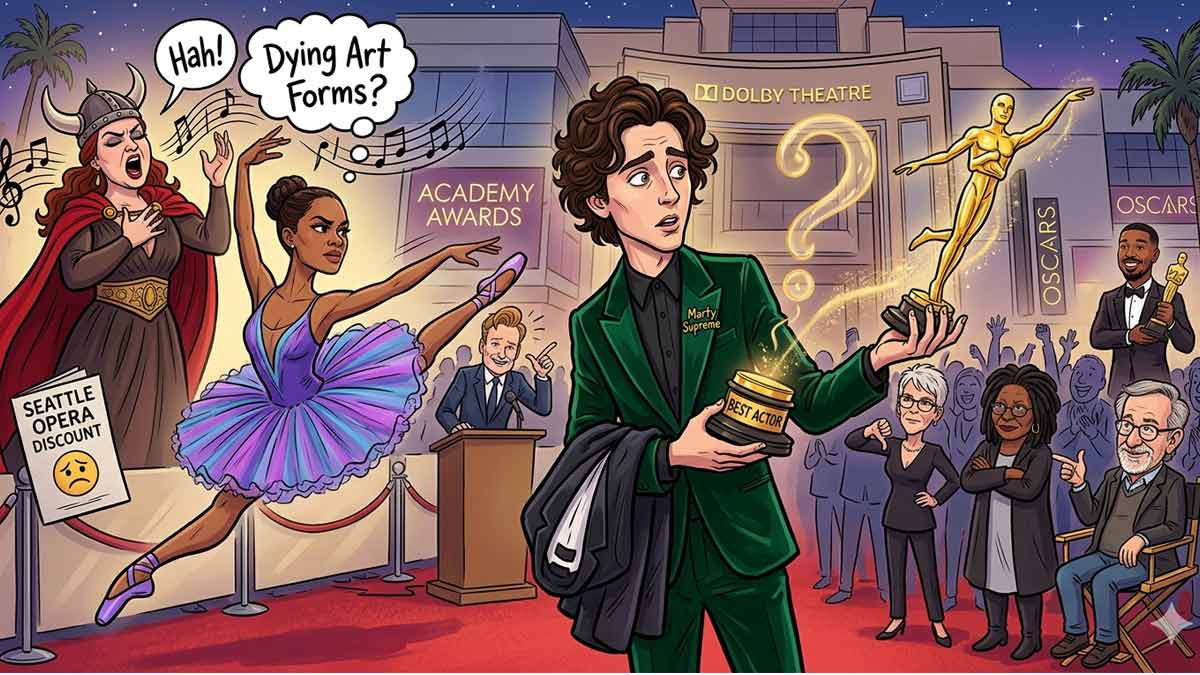
LOS ANGELES: Last night, the 98th Academy Awards delivered a performance that wasn’t in the script, as Michael B. Jordan clinched the Best Actor statue, leaving Timothée Chalamet’s widely predicted win to pirouette away into the night. While Chalamet was long considered the frontrunner for his starring turn in Marty Supreme, many are whispering that a singular, ill-timed performance, not on screen but on the campaign trail, may have rewritten the finale.
For months, the narrative surrounding the race had a singular star, Chalamet, the critics’ darling and the bookies’ bet. However, the closing numbers saw a dramatic plot twist. Chalamet found himself upstaged not just by his fellow nominees but by the ghost of public opinion, following remarks he made during a Variety and CNN actor-on-actor conversation in February.
What started as a breezy discussion turned distinctly frosty when Chalamet, the conversation’s designated trendsetter, took aim at some classical institutions. “I don’t want to be working in ballet or opera, where no one is interested anymore,” he said, before branding them “dying art forms.”

The backlash was swift and, unfortunately for Chalamet’s campaign, star-studded. For the film industry, an establishment that often fancies itself as the glamorous custodian of the high arts, the actor’s comments didn’t just strike a bum note. They sounded like a discordant symphony. Academy heavyweights, including Jamie Lee Curtis, Whoopi Goldberg and Steven Spielberg, publicly voiced their disapproval. Spielberg himself countered that the “cinematic experience” and classical performance are bound by a similar dedication to audience engagement, effectively suggesting that Chalamet’s view was perhaps a bit too modern for its own good.
The conversation quickly became a media maelstrom. In a masterstroke of high-culture clapback, renowned ballerina Misty Copeland didn’t just issue a statement. The Academy even choreographed a surprise performance by her for the ceremony itself, a powerful, wordless rebuttal that many saw as a direct riposte to Chalamet’s dismissive claims. Even regional arts institutions joined the choreography. The Seattle Opera offered a cheeky “TIMOTHEE” discount, granting a 14 percent markdown to prove that people do, in fact, care.
Did this cultural counterpoint truly cost Chalamet his win? While some industry insiders argue that Michael B. Jordan’s complex dual performance in Sinners, a performance that also swept the SAG Awards, had simply built up too much momentum, the timing of Chalamet’s comments was undeniably poor. Coming as final Oscar voting began, they arguably soured his narrative and made a vote for him feel, to some, like a vote against artistic unity.
Even the ceremony itself wasn’t finished with the narrative. Host Conan O’Brien, whose sharp tongue is a celebrated feature of these galas, didn’t miss a beat. “Security is extremely tight tonight,” O’Brien jibed during his opening monologue, glancing toward the front row. “I’m told there are concerns about attacks from both the opera and ballet communities. They’re just mad you left out jazz!”
The laughter that followed was pointed, a final public curtain call for a controversy that Chalamet likely wished had closed weeks ago. Whether it was a case of genuine peer disapproval, a sudden surge in support for Jordan’s powerhouse performance, or simply a case of poor footwork on the campaign stage, the ballet and opera debacle has now cemented its place in Oscar history. Chalamet’s experience serves as a clear memo to future contenders. Even when you are the headline act, a solo performance can still fall flat if you forget to play to the entire house.






Hollywood
Who won what at the Oscars 2026? Full winners list from the 98th Academy Awards
A night of history, high drama, and gingery wit at the 98th Academy Awards
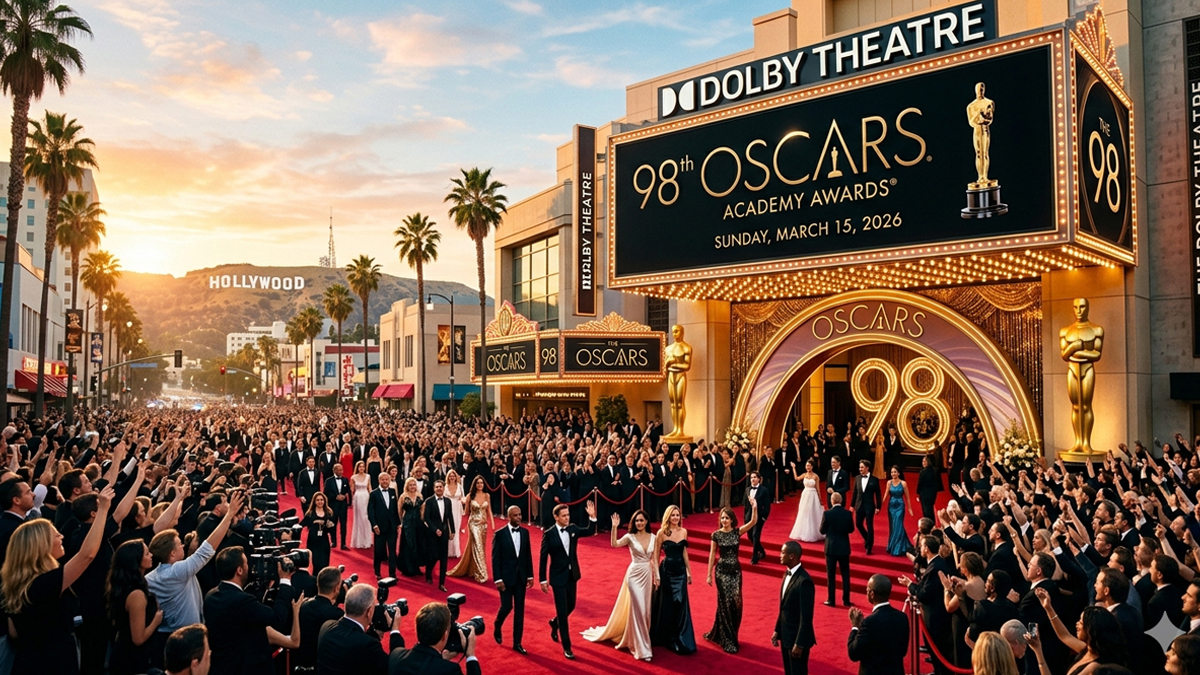
LOS ANGELES: If the 98th Academy Awards taught us anything, it is that Hollywood still loves a tortured genius and a well-timed ginger joke. While the night was technically a coronation for Paul Thomas Anderson’s sprawling war drama One Battle After Another, the real battle was fought in the stalls of the Dolby Theatre as host Conan O’Brien unleashed a monologue that was part roast, part group therapy session.
The evening belonged to the cinematic heavyweights. One Battle After Another lived up to its title, clinching Best Picture, Best Director, and Best Adapted Screenplay. Anderson, the perennial bridesmaid of the Oscars, finally took home the big prizes, cementing his status as the industry’s favourite auteur.
In the acting categories, Michael B. Jordan made history. Winning Best Actor for his visceral performance in the supernatural thriller Sinners, he became only the fourth Black man to win the trophy. His speech was a masterclass in humility, though he spared a moment to thank his trainer for “making me look like I could actually fight a demon.”
The history books were rewritten several times over. Autumn Durald Arkapaw shattered a long-standing glass ceiling by becoming the first woman to win Best Cinematography for Sinners. Meanwhile, the newly minted Best Achievement in Casting category saw its inaugural trophy go to the ensemble of One Battle After Another.
Returning to the stage with his signature quiff and self-deprecating bite, Conan O’Brien did not hold back. He began by acknowledging the elephant in the room: his own presence.
“I know what you’re thinking,” he quipped. “Why is the ghost of a Victorian chimney sweep hosting the Oscars? It’s because AI is too expensive and I work for sandwiches.”
The controversy kicked off when he turned his sights on the Best Visual Effects nominees. Pointing at the Avatar: Fire and Ash table, he remarked:
“James Cameron has spent so much money on blue people that the actual ocean is now jealous of his budget. Jim, at some point, you have to admit this is just a very expensive aquarium hobby.”
He also took a cheeky swipe at the trend of method acting, specifically targeting Sean Penn.
“Sean stayed in character for so long that his own family had to serve him a subpoena just to get him to come to Sunday roast,” O’Brien joked, to a mix of nervous titters and Penn’s trademark stony glare.
The night was not without its “did he really say that?” moments. During a bit about the length of the telecast, O’Brien noted that the show was running so long that:
“By the time we get to Best Picture, the winner will have already been rebooted as a gritty limited series on Max.”
He also touched on the industry’s obsession with youth, pointing at a young starlet and saying:
“You’re so young that your first memory is actually a TikTok of this monologue.”
While most took it in stride, some critics on social media called the joke “typical boomer energy,” though O’Brien seemed entirely unfazed.
The full winners’ circle:
Best Picture: One Battle After Another
Best Director: Paul Thomas Anderson (One Battle After Another)
Best Actor: Michael B. Jordan (Sinners)
Best Actress: Jessie Buckley (Hamnet)
Best Supporting Actor: Sean Penn (One Battle After Another)
Best Supporting Actress: Amy Madigan (Weapons)
Best Animated Feature: K-Pop: Demon Hunters
Best Original Song: “Golden” from K-Pop: Demon Hunters
As the curtains closed and the A-list headed for the after-parties, the mood was one of relief. Hollywood had managed to celebrate its past while poking fun at its increasingly digital future. Whether the night belonged to the war heroes of PTA or the witty barbs of a tall redhead remains a matter of debate.