Brands
Rapido unveils new logo as it shifts to multi-modal mobility
From bike taxis to buses, cabs and travel bookings


MUMBAI: Rapido is changing gears. The homegrown mobility platform has unveiled a new brand identity as it moves beyond its origins as a bike taxi operator to position itself as a full-stack, multi-modal mobility service.
At the heart of the refresh is a redesigned logo. The earlier bike-centric symbol has been replaced with a simplified wordmark, signalling that Rapido is no longer defined by two wheels alone. The clean new look mirrors a broader ambition: to become an everyday mobility companion for millions of Indians.
The shift reflects how far the company has travelled. Rapido now facilitates over five million rides daily across more than 400 cities. What began as a bike taxi service has expanded into auto-rickshaws and cab services, along with parcel deliveries and integrated travel bookings.

Through its in-app OTA feature, users can now book flights, hotels, buses and trains without leaving the platform. The removal of the bike icon from the logo underscores this evolution from a single-category service to a comprehensive mobility ecosystem.
Rapido works with over 30 lakh registered captains across service categories. Powered by a technology-led, SaaS-driven framework, the platform aims to offer flexible earning opportunities while strengthening its footprint in tier-2 and tier-3 cities, where it has seen significant expansion and income generation.
The new identity will be rolled out across the app, captain network, marketing channels, digital platforms and on-ground assets in the coming weeks.
Rapido chief marketing officer Pawandip Singh, said the updated visual language reinforces the company’s promise to be the “Wheels of Bharat”. He added that the brand is moving beyond its origins to deliver an integrated, homegrown solution that connects every Indian from the first mile to the last, and every getaway in between.
As Rapido trades its bike-first badge for a broader mobility mantle, the new logo marks more than a visual tweak. It signals a brand that now wants to move India in every possible way, not just on two wheels.






Brands
KKR sixes to power EV charger rollout under VIDA campaign
Cricket meets clean mobility as big hits spark India’s charging growth
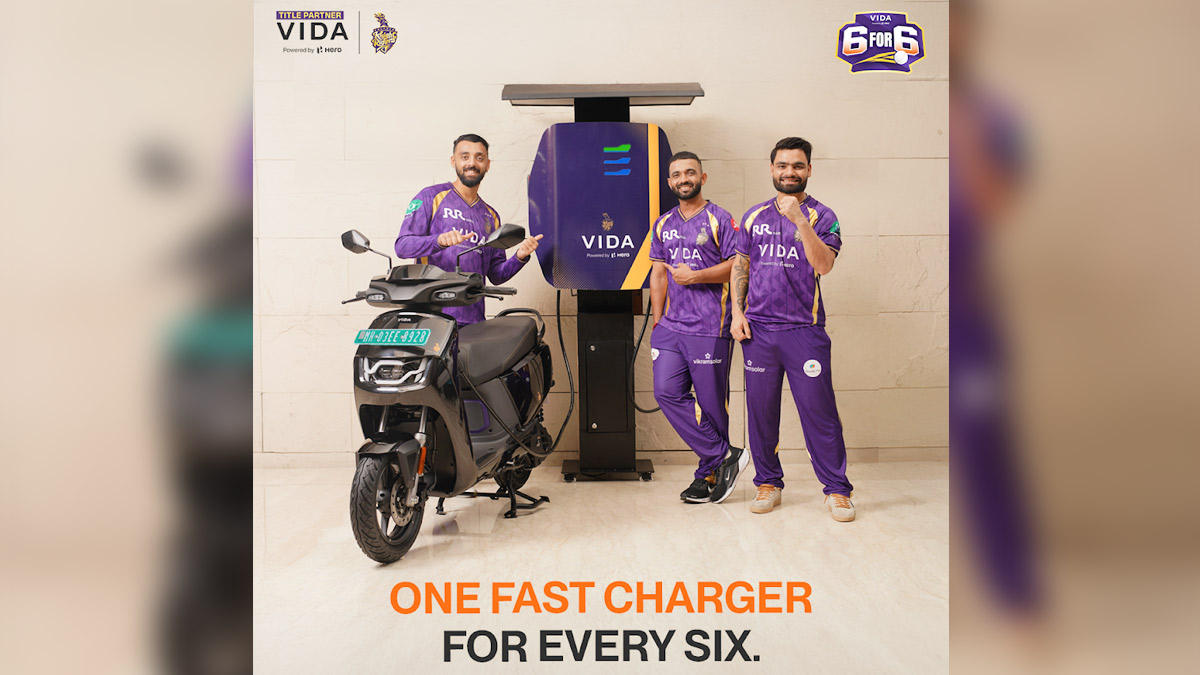
NEW DELHI: VIDA, the electric mobility arm of Hero MotoCorp, has teamed up with Kolkata Knight Riders to launch a campaign that turns cricketing flair into real-world impact.
Titled ‘6 for 6’, the initiative promises to install a 6kW fast EV charger for every six hit by KKR during the ongoing Indian Premier League season. The idea is simple but powerful, as each big hit on the field contributes directly to expanding India’s fast-charging infrastructure.
The campaign builds on VIDA’s growing network, which already spans over 5,300 fast-charging points across more than 430 cities. With EV adoption gaining pace, the brand is using cricket’s mass appeal to accelerate both awareness and infrastructure growth.
Explaining the thinking behind the move, Hero MotoCorp emerging mobility business unit chief business officer Kausalya Nandakumar said, “Cricket has an incredible ability to unite and inspire millions across the country. With the ‘6 for 6’ campaign, we are turning every big hit on the field into a step towards a cleaner and a more accessible mobility future.”
She added that VIDA’s expanding fast-charging network and removable battery technology are designed to make EV ownership more convenient and practical for everyday users.
From the franchise’s side, the campaign is also about giving on-field moments a larger purpose. Kolkata Knight Riders chief executive officer Venky Mysore said, “The ‘6 for 6’ campaign exemplifies the potential of sport as a platform for meaningful, real-world impact. By linking every six to the expansion of EV charging infrastructure, this partnership transforms fan excitement into tangible progress.”
As part of the rollout, VIDA has introduced co-branded charging stations in KKR’s signature colours, with a flagship installation unveiled alongside team players. The chargers are designed for quick top-ups, powering VIDA scooters from zero to 80 percent in about an hour, while also being positioned along key highways to support longer journeys.
The initiative also taps into VIDA’s removable battery system, which allows users to charge using standard household plug points, adding flexibility to the charging ecosystem.
By blending the thrill of cricket with the urgency of clean mobility, VIDA and KKR have found a neat way to make every six count twice, once on the scoreboard and again on India’s road to an electric future.








