MAM
Nothing’s pink phone tease sparks viral buzz
Tech firm Nothing India blends nostalgia with innovation in cheeky Rooh Afza campaign for upcoming Phone 4a launch.

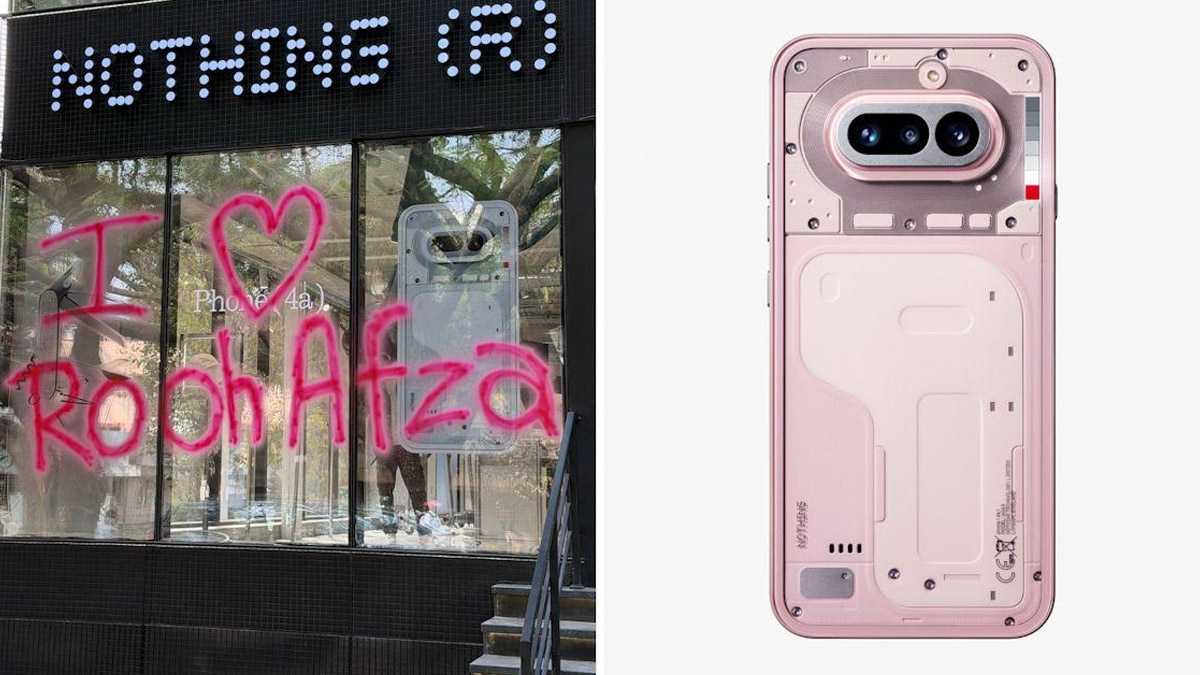
MUMBAI: Nothing’s stirring the pot or rather, mixing up a rosy elixir with a campaign that’s got Bengaluru abuzz and social media fizzing like a summer sherbet. In a clever nod to India’s beloved pink-hued Rooh Afza drink, the London-based tech upstart Nothing has splashed its Bengaluru flagship store in Indiranagar with graffiti proclaiming “I love Rooh Afza” in vibrant pink spray paint. What first looked like cheeky vandalism to passers-by has turned out to be a masterful marketing ploy, teasing a fresh pink colour variant for the Nothing Phone 4a, set to debut on 5 March alongside the Phone 4a Pro.
Launched on 25 February, the campaign taps into cultural nostalgia, with Nothing’s India handle posting gems like “I don’t usually be poppin’ bottles but when I do it’s Rooh Afza.” It’s the brand’s first foray into pink across its smartphone lineup, positioning the shade as “expressive and optimistic” rather than just another hue. The move has sparked online chatter, from amused locals filming the store window to comments ranging from “paid collaboration” to playful jabs like “now Rooh Afza may write Nothing on their bottles.”
Nothing isn’t stopping at graffiti; activations have popped up across stores, including in London, blending street art with tech hype. As whispers of vandalism gave way to viral reels, one Instagram post clocked thousands of views in hours, the stunt has cleverly woven tradition into modern gadgetry, proving that sometimes, a splash of pink is all it takes to refresh a launch.

With the global rollout on 5 March at 10:30 GMT, expect the Phone 4a to shake up the mid-range market, pink variant and all. Whether it’s a hit or just fizzy fun, Nothing’s campaign shows how a dash of local flavour can turn heads in a crowded tech scene.





Brands
E-commerce growth rises, but profits come under pressure
Shop Culture flags rising costs, weak systems and a $5.38 billion quick-commerce boom reshaping global retail

MUMBAI: E-commerce is booming, but profits are thinning. A new report by Shop Culture warns that brands clinging to outdated, growth-at-all-costs strategies are being outpaced in a costlier, more complex 2025 landscape.
Global online retail is expected to cross $6.86 trillion this year, with 2.77 billion shoppers making at least one purchase. Yet returns are under strain: average return on ad spend has slipped to 2.87:1, exposing cracks in how brands chase scale without building sustainable margins.
Three shifts are rewriting the rules. First, retail media is getting pricier, with Amazon’s average cost per click rising 15.5 per cent year-on-year to $1.12. Second, while 77 per cent of e-commerce professionals now use AI daily, many see limited gains as weak systems blunt its impact. Third, geography is no longer expansion, it is strategy. The share of Shop Culture clients operating across multiple markets has more than doubled, from 30 per cent in 2024 to 65 per cent in 2025.
Subarna Mukherjee, founder and ceo, Shop Culture, is blunt: “The e-commerce industry has a nostalgia problem. In 2022, the playbook was simple: list aggressively, spend on ads, and ride the wave of post-pandemic digital adoption. It worked. Revenue grew rapidly. But by 2025, the industry is seeing the consequences of those structural shortcuts. E-commerce itself is not slowing down, the challenge lies in how brands are operating within it.”
Nowhere is the shift sharper than in India’s quick-commerce boom. The segment is set to hit $5.38 billion in 2025, growing 17 per cent and emerging as the fastest-growing globally. What began as a convenience play is fast becoming a margin buffer. In one case, quick commerce drove 70 per cent of a packaged food brand’s online revenue, delivering 130 per cent year-on-year growth. A beauty brand, meanwhile, saw selling prices rise 25 per cent higher than on traditional marketplaces.
Expansion, too, is being rethought. The report argues that brands chasing the largest markets first often stumble. Better outcomes come from sequencing entries based on efficiency, regulatory readiness and competition, with markets such as the UK and Germany offering smarter entry points than the United States.
Compliance has turned from a checkbox into a revenue lever, especially in Europe. Brands with ready frameworks can go live in 8 to 12 weeks, while others risk delays of six months or more due to listing and documentation hurdles.
AI, for all the hype, is no silver bullet. Across more than 1,500 listings, it improved conversion rates by 10 to 15 per cent, cut TACOS by 7 to 10 per cent and reduced stockouts by 20 per cent, but only when layered on strong foundations. As Mukherjee puts it: “AI is not a growth strategy, it is an amplifier. It enhances strong systems and exposes weak ones.”
The message for 2026 is stark. Growth alone will not save brands. Margins, discipline and smarter strategy will. In a market still expanding at breakneck speed, the real race is no longer for scale, it is for survival.