Brands
Mumbai’s iconic 97-year-old Parle-G factory gets clearance for commercial redevelopment


MUMBAI: Mumbai’s industrial past is being dismantled brick by brick—and replaced with glass, steel and balance sheets.
The iconic Parle-G biscuit factory in Vile Parle East, where India’s best-known FMCG brand was born, has received clearance for redevelopment into a large commercial complex, marking another milestone in the city’s relentless conversion of legacy industrial land into real estate gold.
The redevelopment plans were first submitted to the Municipal Corporation of Greater Mumbai in mid-2025, followed by applications for environmental approvals, according to a Hindustan Times report.

The Parle Products land parcel spans 5.44 hectares (13.45 acres) and will be redeveloped with a total built-up area of 1,90,360.52 sq m. Of this, 1,21,698.09 sq m falls under Floor Space Index (FSI), while 68,662.43 sq m is classified as non-FSI construction. The estimated project cost stands at Rs 3,961.39 crore.
The proposed commercial project will comprise four buildings, each with two basement levels. The A-wing of the first three buildings will rise to six floors. In Building 1, the B-wing will include retail and office spaces on the first, seventh and eighth floors, while floors two to six are designated for parking. The complex is expected to house retail outlets, restaurants and food courts.
The Parle redevelopment is the latest chapter in Mumbai’s sweeping reinvention of its industrial landscape. From shuttered textile mills in Central Mumbai to former factories in the suburbs, land that once powered Bombay’s manufacturing economy is now being monetised to fuel a services-led future.
The transformation began in the 1990s with the decline of the textile industry and accelerated after changes in development control regulations unlocked vast mill lands in areas such as Lower Parel, Worli, Mahalaxmi and Prabhadevi. Landmark redevelopments at Phoenix Mills, Kamala Mills, Bombay Dyeing Mills and others reshaped the city’s skyline, blending luxury housing, offices, malls and hotels. High Street Phoenix emerged as a template for mixed-use urban regeneration.
The shift has since spread beyond textiles. Across Andheri, Kurla, Goregaon and Mulund, old biscuit factories, engineering units and warehouses have been converted into IT parks, co-working hubs and residential projects, mirroring Mumbai’s broader move away from manufacturing.
More land is waiting in the wings. Railway land, Mumbai Port Trust parcels along the eastern waterfront, and salt pan tracts in the suburbs are expected to unlock the next wave of large-scale redevelopment over the coming decade.
As infrastructure improves in satellite cities around Mumbai, industries are steadily moving out, freeing up prime urban land for redevelopment. The logic is simple: cheaper land outside, richer returns inside.
Mumbai, it seems, is no longer baking biscuits. It is baking balance sheets—and the oven is still hot.







Brands
Ace Blend launches 10:1 Shroom Droppers targeting energy, focus and calm
New ultrasonic extracts aim to boost potency and absorption in mushroom supplements
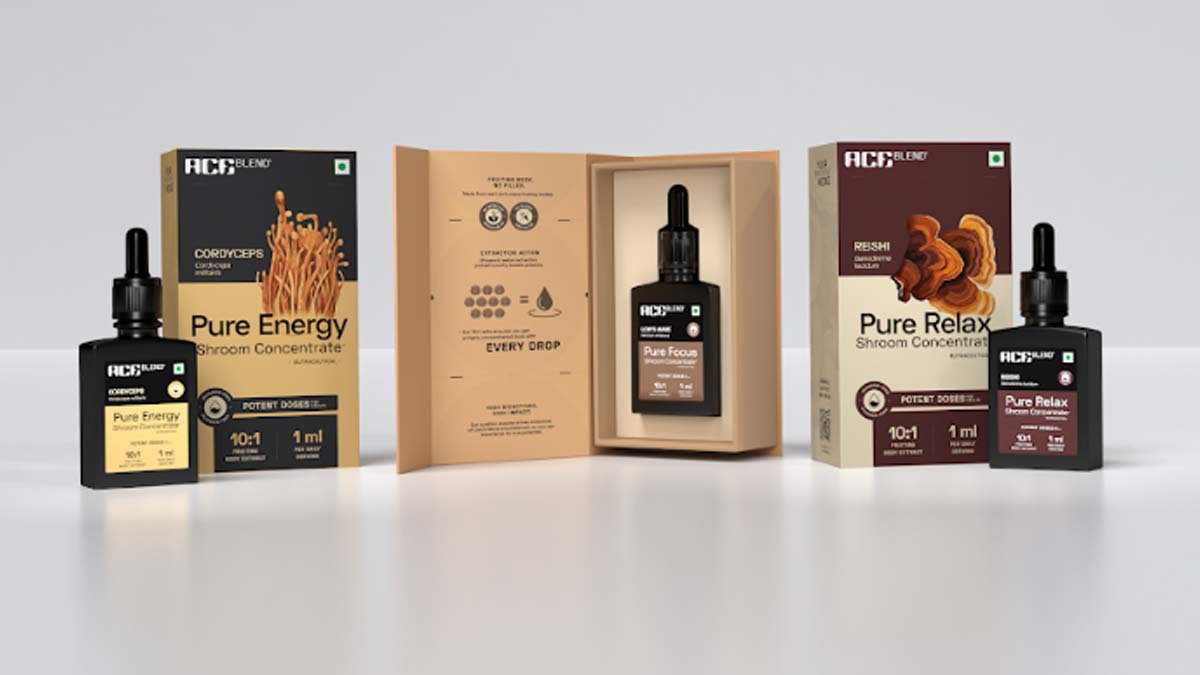
MUMBAI: Ace Blend has entered the fast-growing functional wellness space with the launch of its new Shroom Concentrates range, betting on potency and delivery format as key differentiators in an increasingly crowded market.
The Mumbai-based brand has introduced a trio of liquid “droppers” designed to support focus, energy and relaxation. Unlike conventional mushroom supplements, which often rely on powders or capsules, the company is positioning its water-based concentrates as faster-absorbing and more effective.
At the core of the launch is a 10:1 concentration ratio, which the company says delivers higher bioactive potency compared to standard formulations. The products are developed using a patented ultrasonic water extraction method that uses sound waves instead of heat or chemicals to preserve delicate compounds within the mushrooms.
The range includes Lion’s Mane for cognitive support, Cordyceps for sustained energy, and Reishi for relaxation and recovery. The formulations are also glycerin-free, a move aimed at avoiding dilution and maintaining purity.
“We introduced India to functional mushrooms with our Shroom Coffees. With Shroom Concentrates, we’re cementing our expertise in the space,” said Ace Blend founder Shivam Hingorani. “We focused on solving that gap by improving how these compounds are extracted, delivered, and absorbed.”
The launch comes as functional mushrooms gain traction globally, with consumers increasingly seeking natural solutions for productivity, stress management and overall wellbeing. In India, the category is still emerging, but growing awareness and demand for performance-oriented health products are creating new opportunities.
By combining high-potency extracts with a convenient dropper format, Ace Blend is aiming to make functional mushrooms more accessible to everyday users rather than niche wellness enthusiasts.
As competition intensifies in the plant-based supplement market, brands that can deliver both efficacy and ease of use may find themselves a step ahead. For Ace Blend, this latest launch signals an attempt to turn curiosity into consistent consumption.






