MAM
How an SIP calculator helps you compare ₹5,000, ₹10,000, and ₹15,000 monthly SIP outcomes


Investing ₹5,000, ₹10,000, or ₹15,000 a month can look like a small decision, yet it can reshape what your money may become over the next decade. When you compare these amounts side by side, the difference is not simply the extra contribution, it is the compounding time you buy.
A Systematic Investment Plan (SIP) calculator turns a guess into a comparison. The SIP calculator displays projected corpus and estimated gains for each SIP amount. That context matters because investments in SIP is already a mainstream habit in India, with monthly SIP contributions reported at ₹31,002 crore in January 2026.
In this blog, you will learn how to set up a comparison using an SIP calculator to decide what fits your cash flow and goals.

Comparing the three SIP amounts under one consistent setup
A higher SIP amount does two things at once. It increases the total invested, and it increases the amount that stays invested long enough to compound. Comparing ₹5,000, ₹10,000, and ₹15,000 side by side helps you see two things. One question is whether it is better to increase the monthly contribution or extend the duration of the goal you have in mind.
This is also where an SIP calculator adds discipline. When return and duration stay constant, you can isolate the impact of the monthly SIP amount without mixing in multiple variables. This keeps the comparison clean and makes it easier to judge what each level may deliver, and what it asks from your monthly cash flow.
- ₹5,000 monthly SIP outcomes
A ₹5,000 monthly SIP over 10 years means you invest a total of ₹6,00,000. Assuming an annual interest rate of 5%, the SIP calculator projects an estimated future value of ₹7,79,647. This implies an estimated gain of ₹1,79,647 over the total invested amount. The following level often suits a disciplined start, especially when you want a long-term habit without locking yourself into a tight monthly commitment.
What makes ₹5,000 useful is that it gives you room to stay consistent even during months when expenses rise. It can also work well when you split contributions across priorities, particularly when building positions across mutual funds in India while keeping risk balanced.
If you plan to scale, ₹5,000 also becomes a practical base for a step-up approach, where you increase the SIP gradually as income grows.
When ₹5,000 can be a sensible fit
- You want to build consistency first, then increase later
- You are balancing several goals and need flexibility
- You prefer a comfortable SIP that can run uninterrupted
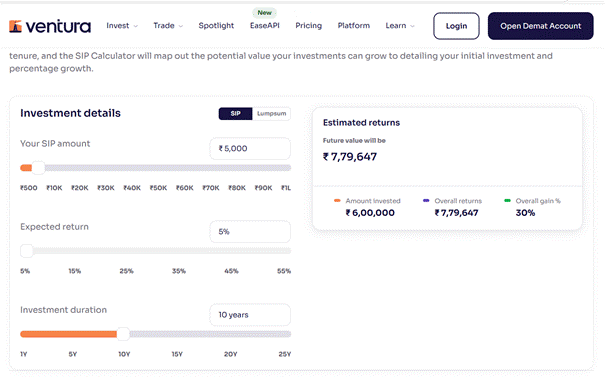
Image Source: Ventura
- ₹10,000 monthly SIP outcomes
At ₹10,000 per month, your total invested amount doubles to ₹12,00,000 over 10 years. Assuming the same annual interest rate of 5% and the same duration, the SIP calculator projects a future value of ₹15,59,293. This indicates an estimated gain of ₹3,59,293. The gain percentage remains unchanged because the assumptions are the same, but the rupee outcome becomes more meaningful for goal planning.
This band often feels balanced because it improves projected corpus momentum without forcing a longer timeline. It is also a practical “step-up” point from ₹5,000, especially if your monthly budget can accommodate it comfortably.
Many investors use this level to keep the plan stable while still moving towards mid-to-long term goals with stronger visibility.
When ₹10,000 can be a sensible fit
- You want a stronger projected corpus without extending the duration
- You can commit consistently without it affecting other monthly priorities
- You are planning a defined milestone and want clearer progress tracking
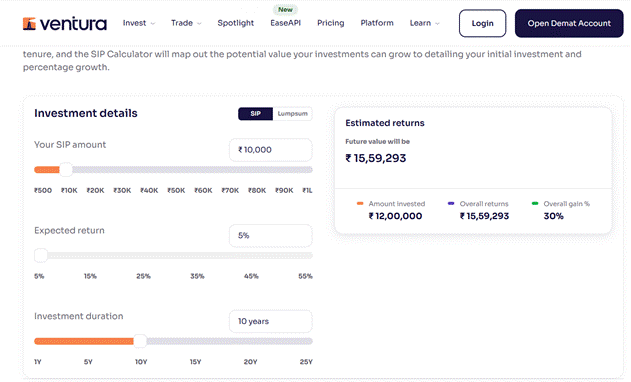
Image Source: Ventura
- ₹15,000 monthly SIP outcomes
At ₹15,000 per month, the invested amount rises to ₹18,00,000 over 10 years. Under the same assumptions of a 5% annual interest rate and a 10-year investment period, the SIP calculator projects a future value of ₹23,38,940. This implies an estimated gain of ₹5,38,940 over the total invested amount. It is the strongest corpus outcome in the comparison because more capital stays invested throughout the full decade.
The premium advantage here is timeline efficiency. If your goal requires a larger corpus within a fixed time window, increasing the SIP amount can be more direct than extending the duration.
That said, this level works best when it does not strain cash flow, because the real benefit depends on consistency. If ₹15,000 feels aggressive right now, a step-up plan starting at ₹10,000 can be a more sustainable path to similar long-term outcomes.
When ₹15,000 can be a sensible fit
- You want a higher projected corpus within the same 10-year horizon
- Your monthly budget supports it comfortably, even in uneven months
- You prefer increasing the SIP amount rather than extending the timeline
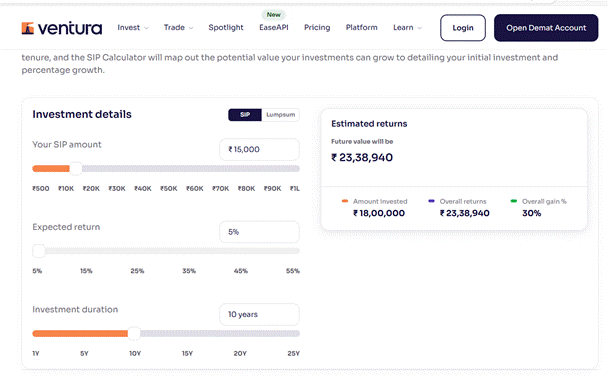
Image Source: Ventura
Monthly SIP Total Invested (10 Years) Projected Future Value Estimated Gains ₹5,000 ₹6,00,000 ₹7,79,647 ₹1,79,647 ₹10,000 ₹12,00,000 ₹15,59,293 ₹3,59,293 ₹15,000 ₹18,00,000 ₹23,38,940 ₹5,38,940
Key insights from the SIP calculator
When you run these three amounts through an SIP calculator with identical assumptions, the output reveals something that isn’t immediately obvious. It is the relationship between contribution and outcome is linear when variables are controlled.
Here’s what this means for your decision:
- The proportionality check
With return and duration fixed, the projected corpus rises in direct proportion to the SIP amount. Moving from ₹5,000 to ₹10,000 doubles the invested amount and doubles the projected corpus, and ₹15,000 lifts it further under the same setup. This is useful because it shows exactly what a higher monthly commitment changes, especially when comparing different categories of mutual funds in India under the same assumptions.
- The compounding takeaway
The gain also scales up as the SIP increases because more money stays invested over the full decade. A key takeaway here is that returns are never guaranteed, yet time continues to compound steadily in the background.
To test the power of time more clearly, rerun the same three SIP amounts over 15 years using the same 5% return assumption. Then compare how the gap between the invested amount and projected value widens.
- The cash flow reality check
The SIP calculator’s value is the discipline it demands. ₹15,000 may project a higher corpus, but it also requires ₹18 lakh of total contributions over 10 years. That makes the decision clearer: the “best” SIP amount is the one you can maintain through every kind of month.
- The step-up option for practical scaling
If ₹15,000 feels like a stretch today, model a step-up path. Starting at ₹10,000 and increasing the SIP annually can move you closer to the higher-corpus outcome without front-loading stress. This approach often improves consistency, which is what long-term outcomes depend on most.
Make your SIP decision with clarity and consistency
An SIP calculator helps you compare ₹5,000, ₹10,000, and ₹15,000 in a like-for-like way by keeping the timeline and return assumption constant. When the outcomes sit side by side, the decision becomes more practical. You can assess which monthly amount fits your cash flow, which corpus target feels achievable, and how long you are willing to stay invested.
For stronger planning, rerun the same SIP amounts across a range of return assumptions and longer durations, so you can see how time changes the separation between outcomes. Online investment and trading platforms like Ventura make these comparisons easy to run and revisit. The real win is building an SIP that stays consistent, aligns with your preferred mutual funds in India, and gets reviewed once a year as your income and goals evolve.
Site Disclaimer: This article has been published without the journalistic or editorial involvement of indiantelevision.com, IndianTelevision.com Group, or any of its affiliated websites. IndianTelevision.com Group does not endorse, subscribe to, or take responsibility for the content, opinions, or views expressed herein.
Readers are further advised that Online Casino, Betting, Cryptocurrency products, Financial Investments/Engagements, NFTs, and products or calls-to-action related to Health, Booking, Wellness, and Food are largely unregulated and carry significant risk. There may be no regulatory protections or avenues for recourse in the event of financial losses or health-related risks arising from engagement with such products or services.
IndianTelevision.com Group expressly disclaims any responsibility or liability for the information, views, announcements, declarations, or affirmations presented in this article. By choosing to proceed, the reader acknowledges and agrees that they do so at their own discretion and risk, and expressly absolve indiantelevision.com (IndianTelevision.com Group) from any potential legal claims, liabilities, or actions.
The content provided is solely for informational and awareness purposes







MAM
India’s summer is no longer a season, it’s a business event: Anindya Ghosh on summer marketing
Why Anindya Ghosh believes climate unpredictability and quick commerce are rewriting summer demand

MUMBAI: Every February, a particular kind of brief begins its migration through Indian marketing teams. The mood boards fill up with mangoes and sweaty foreheads. The taglines arrive pre-assembled. “Beat the heat.” “Cool down with us.” Anindya Ghosh, co-founder of Mumbai-based agency Sam and Andy, has received this brief many times. And every time he does, he asks his client the same question.
“Is your product going to go off the shelf after the summer is over?” he says. “That is the first question. Are you immediately going to roll it back after the summer?” The client starts laughing. They say, “No, it is not possible.” He then responds, “So then why are you pushing it just for this window? It has a far bigger utility. It has a far bigger role in the life of the consumer. Do not restrict the role of the brand or the product to a particular, very short window.”
That tension between the tactical and the enduring is at the heart of everything Sam and Andy does. Ghosh and his co-founder Sameer started the agency in 2018, after spending nearly a year deciding what they did not want to build. Not another creative boutique. Not a performance shop.
“We figured out that what we call the middle-India client, typically the client who is at 100 crore, 200 crore, 500 crore, or 1,000 crore, actually requires a lot of handholding when it comes to creating revenue out of a brand,” Ghosh explains. “Neither the top fifteen or twenty ad agencies will approach them, nor will the big four or big six consulting firms, because it is not glamorous, it is not fame. But these are the people who actually value clarity, who actually value strategic inputs that move the needle of the business.”
The agency today runs six divisions: strategy, creative, performance marketing, content, design, business analytics and a recently added BTL activation unit. The founding team between them brings forty-six-plus years of experience. Sameer came from J. Walter Thompson, McCann and Rediffusion. Ghosh himself has worked at Johnson & Johnson, Star TV, Madison, Aditya Birla Retail and he was one of the youngest chief strategy officers in the country, overseeing markets across Bangladesh and four South-East Asian nations.
That emphasis on experience is reflected across the organisation. They largely lean towards experienced talent, with even the most junior team members bringing five to seven years of experience. When asked whether this could be a handicap in an industry obsessed with reaching Gen Z, Ghosh is direct.
“Gen Z is a tag that has been put on a set of people. But today, business demands maturity. Business runs like a marathon. Business is not a sprint or a shortcut. We have skin in the game. We have accountability. We have to deliver numbers. We have to get into the depth of a problem to find a solution. That needs a lot of rigour, a lot of patience, and a lot of hard work.”
He adds, with a candour that suggests he has thought about this carefully, that he has a daughter in that age group. The people on his digital team are, demographically, Gen Z. They are just, as he puts it, “very fundamental people.”
It is this mix of experience and grounded thinking that also shapes how Ghosh looks at larger market trends. His central argument about summer marketing, for instance, begins with a fairly blunt observation: the old model is broken, and it has been upended by a combination of climate change and quick commerce.
“Today’s summer in India is no longer a season. It is a high-speed consumption event shaped by heat, hyperlocal demand, and instant gratification,” he says. “Summer demand is no longer predictable. It is a combination of what I call temperature, technology, and timing.”
He points to his family spread across Dehradun and Bardhaman. “The summer started towards the beginning of February this year. Holi happened on 3rd March and from the beginning of February, you were getting heat waves.” IMD had forecast a harsher, longer winter. It did not arrive. The weather, in other words, has stopped respecting the marketing calendar.
But climate unpredictability is only one part of the shift. The other is a wholesale category-level rebrand of what summer means. “We have moved from cola to coconut water to kombucha. Today, sunscreen is the new fairness cream. SPF is becoming a daily habit,” Ghosh says. “Dabur has converted Chyawanprash into immunity drinks. Electrolytes and protein shakes are trying to create a healthy conversation and not a heat conversation. So it is not about the thirst. It is about the health, the energy, the skin, and overall wellness.”
The old advertising vocabulary has shifted too. Dermicool’s “chubti jalti garmi,” the glucose ads about the sun stealing your energy, the Frooti and Maaza spots. Ghosh notes, with evident amusement, that there was a time when the National Egg Coordination Committee ran campaigns to counter the widespread belief that eggs should be avoided in summer.
That thinking, he says, has all but disappeared. Protein-based products are now gaining traction even in peak summer. “The whole direction is changing. From heat, it is moving more towards health.”
Even travel has been folded into this reframe. Tanning, once something Indians actively avoided (see: the entire fairness cream industry), is being repositioned as a lifestyle marker. “People are travelling not only to Shimla or the cooler parts, but even to hotter places. But they have a different way of treating that summer. So summer as a season is sacrosanct. But the way we are treating and approaching summer has changed a lot and continues to change a lot.”
It is this broader shift in how summer is perceived and experienced that has led Sam and Andy to formalise their thinking. The agency has developed an internal framework for navigating the season, which they call the HEAT model, and it begins with a reframe of the question itself.
“Am I attacking the summer, or am I attacking the climate unpredictability?” Ghosh asks. “When you attack the climate unpredictability, your window and your worldview perspective changes. Your brand’s delivery, your brand’s promise, and your brand’s moment of truth changes. That makes the brand far more agile beyond just those three months of April, May, and June.”
H is for Hyperlocal Demand. “Today, it rains in some places in summer in ways that are totally unpredictable. A place in Rajasthan might get rains in May and June. You have to understand hyperlocal demand. Google data gives you a weather report at a hyperlocal level. You have to have a city-by-city strategy, because your climate is also changing city by city.”
E is for elastic consumption, where demand can shift within hours. “If it is pleasant in the morning but turns very hot later, demand changes instantly,” says Ghosh. “So how do you tackle that?” He points to an ice cream company that claims it can supply a dark store within two hours, setting a new benchmark for supply chain speed. Elastic consumption, he adds, is driven by both temperature and mood. “Mood is part of culture. You create it through communication, and suddenly a family decides to have a Rooh Afza falooda.” The difference now is immediacy. “You do not need to step out. You can get it home in ten minutes.”
A is for Aspirational Bharat, which for Ghosh is less a marketing insight and more a lived observation. “Whatever product my sister’s family gets through Blinkit in Bardhaman, I get the same category of product through Blinkit in Mumbai. So we are at par in terms of aspiration and consumption. And this Bharat is moving faster than metros.” In the paint category, he says, smaller-town consumers are actively choosing premium paints that promise to reduce indoor temperatures by five to seven degrees, rationally weighing a 100 to 200 rupee extra per can as a quality-of-life investment. Metro consumers, he suggests, would not bother.
T is for time compression. “The purchase cycle has gone down from days to minutes.” He offers a simple example from his own home. His cook used to flag a vegetable shortage and wait for instructions. “Today, my cook says, ‘There is no onion.’ And then, ‘Order it on Blinkit, it will come in ten minutes. Till then, I will cut something else.’” Quick commerce, he says, is not just a distribution channel. It is a behavioural shift that has made hoarding obsolete.
This shift in behaviour naturally raises a larger question around how brands should respond to quick commerce. Should advertising be designed differently for a ten-minute purchase journey? Ghosh is characteristically blunt in his response. Distribution channels, he says, are not brand strategy.
“The most important thing is memory structure. How do you create memory structures where the distribution platform is just the last mile to reach, but will not influence your decision?” he says. He illustrates this with ID Fresh. When you order their dosa batter on Zepto, the app may suggest swapping to a cheaper alternative. Whether you resist that prompt depends entirely on whether ID Fresh has spent years showing you their factory, validating their product with grandmothers and building an emotional association with authentic home cooking. “How ID Fresh delivers that is not about the product alone. It is about the belief they have created over a period of time.”
He is equally sceptical of moment marketing as a substitute for strategy. “Moment marketing is very tactical. It is needed. But the most important thing is memory structure.” The Hajmola outdoor ad he cites during the cooking-gas shortage is his favourite example of this done right: the copy read, in effect, “Dekha ho gaya na gas khatam.” It required no big media buy. Just someone paying attention and understanding what the brand could legitimately say. “It does not need a big window. It needs something relevant for today.”
On IPL, which consumes a disproportionate share of summer marketing budgets, he is pragmatic. State-level cricket leagues offer brands a way to buy into cricket culture without bleeding the annual budget in a fortnight. Women’s cricket has opened a new frontier entirely. And beyond cricket, he argues, there are always other conversations to enter. “From the last two days, it has been all about Dhuranda 2. If I am a smart brand and I have integrated myself into Dhuranda 2, I know the mileage I am getting.”
He prefers the term “consumption clusters” over moment marketing for events like IPL, heat waves and school holidays. “Relevance and reach both have to work. Each consumption cluster has to be tackled differently at the tactical execution level, while the overarching strategy has to remain constant.”
It is this belief in balancing strategy with sharp execution that also shapes how Ghosh evaluates great summer advertising. His personal benchmark is not a recent campaign, but a Kelvinator refrigerator advertisement from twelve to fifteen years ago. The ad features a man attempting to sing classical music, with a Kelvinator fridge behind him. When the door opens, he sings in perfect sync, the vocal by Shankar Mahadevan. When the door closes, everything collapses into chaos.
“The product truth, delivering the coldest fridge, got intertwined into the nuances of culture: the culture of Indians being classical, the culture of singing at home. It is not preachy. It is not product literature or a product brochure. It is a balanced piece of work where the consumer will hardly miss this ad because it has a hook to it, and it delivers on what it promises.”
That, in essence, is the standard he holds all summer marketing to. The failure mode, he says, is myopia. “You are either too in love with the product or too in love with the culture. You sometimes forget to balance out the product and the culture.” The result is either a product brochure dressed as an ad, or a beautifully crafted cultural moment that has nothing to do with what the brand actually sells.
The smartest brands, he argues, are the ones already converting the summer’s cultural anxiety into something more sustainable. “Rather than calling it a heat season, this is a healthy season. They are converting the heat season into a healthy season. Heat waves are the new Black Friday for FMCG. And if I call it a Black Friday, that is a sense of new culture being layered into it.”
And for any brand still wedded to the three-month summer window, Ghosh has a simple reminder. “If you live in Mumbai, you know that in September, it is very hot. And there is something called the October heat. During Diwali, it is very hot. Look at your electricity bill. The October-November electricity bill is at par with the summer bills. So are you only meant for Q1? Or are you meant for Q1, some part of Q2, and definitely the beginning of Q3?”
On a subcontinent where summers now begin in February, where Holi is warm and October scorching, where the monsoon arrives on its own terms and heat waves show up uninvited, the old marketing calendar was always a fiction. The brands that thrived understood that India’s weather was never really the point. The people, their moods, their aspirations, their ten-minute Blinkit orders and their grandmother-approved dosa batter, that was always the point. Anindya Ghosh and Sam and Andy are simply saying what good strategists have long known: seasons change, but the consumer does not stop. Any brand worth its brief should be ready for that, in February, in June, in October, and every unpredictable day in between.