Brands
Oben Electric honours Bengaluru traffic Police at red signals

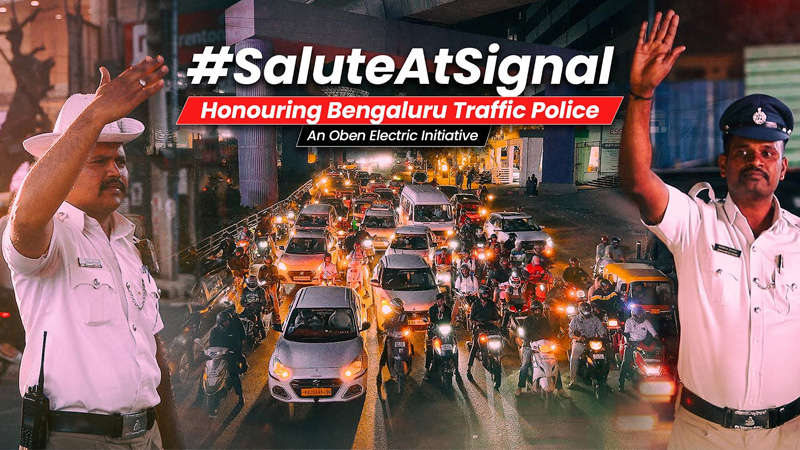
BENGALURU: In a city where red lights usually test patience and tempers, Oben Electric decided to give them a new job. For one week, Bengaluru’s busiest junctions became unlikely stages for gratitude, as commuters paused not just for traffic, but for the people who manage it.
Marking National Road Safety Month, the electric motorcycle maker rolled out Salute At Signal, a city-led initiative that invited motorists to acknowledge Bengaluru Traffic Police at red signals. The idea was disarmingly simple. At selected junctions, drivers and riders were encouraged to switch on their parking or hazard lights for a few seconds, stay still, avoid honking and quietly recognise the officers on duty.
The result was a rare sight in peak-hour Bengaluru. Calm intersections, collective stillness and a moment of shared respect where chaos usually reigns.

The initiative ran for a week at Sony Signal in Koramangala and Vydehi Signal in Whitefield, two pressure points that handle tens of thousands of vehicles daily. Between 6 pm and 9 pm, public announcements nudged commuters to take part, transforming routine red lights into small but meaningful gestures.
At Sony Signal, the spotlight fell on Shanoor Nadaf (PC 15996) of the Adugodi Traffic Police Station. With nine years of service, he manages traffic for close to eight hours a day, including nearly five gruelling peak hours, at an intersection that sees close to one lakh vehicles per shift. Over in Whitefield, Sangamesh Desai (PC 18308) was recognised for his nine years with the Bengaluru Traffic Police, overseeing around 15,000 vehicles per shift during long daily duty hours at Vydehi Signal.
Informational boards at both junctions laid out the realities of the job. Names, years of service, duty hours and vehicle volumes were displayed for all to see, turning anonymous uniforms into recognisable faces and stories. For many commuters, it was the first time the scale of effort behind smooth traffic became visible.
Thousands participated over the week, proving that even in a city famed for gridlock, empathy can travel faster than frustration.
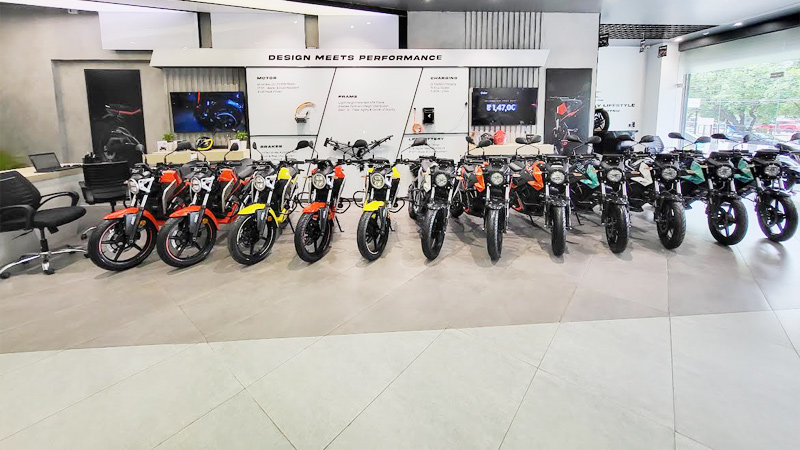
For Oben Electric, the campaign fits neatly with its broader focus on safety and responsible urban mobility. Designed and manufactured at its Bengaluru facility, the company’s electric motorcycles and patented LFP battery technology are built with everyday city riding in mind. Its Rorr range is tailored for Indian road conditions, where reliability and safety are not optional extras.
With more than 85 showrooms across 70 cities and plans to scale up to 150 by March 2026, Oben Electric’s ambitions are clearly national. But Salute At Signal kept things refreshingly local, reminding Bengalureans that road safety is not just about rules and machines. Sometimes, it starts with a pause, a light switched on and a simple thank you at a red signal.



Brands
Dunkin’ Donuts to exit India as Jubilant FoodWorks ends 15-year franchise deal
The quick service restaurant giant is ending a 15-year franchise partnership with the American doughnut chain, even as it renews its Domino’s agreement for another 15 years
NOIDA: Dunkin’ is done in India. Jubilant FoodWorks Ltd, the country’s leading quick service restaurant operator, has decided not to renew its franchise agreement with the American coffee and doughnut chain, and will wind down its Indian stores in a phased manner before December 31, 2026, bringing a 15-year partnership to a quiet, loss-laden close.
The decision, approved by JFL’s board on March 30, 2026, ends a relationship that began with a Multiple Unit Development Franchise Agreement signed on February 24, 2011. JFL will now evaluate and undertake what it described in a regulatory filing as the “rationalisation and/or cessation of certain operations and/or sale, transfer or disposal of assets and/or assignment or transfer of franchise rights,” all in consultation with Dunkin’s brand owners and strictly within the terms of the original agreement.
The numbers tell the story bluntly. In the financial year 2024-25, Dunkin’ India posted a revenue of Rs 37 crore against a loss of Rs 19 crore — a haemorrhage that was always going to test the patience of a parent company recording revenues of Rs 6,104 crore and a profit of Rs 194 crore in the same period. Doughnuts, it turns out, were never going to move the needle.
The contrast with JFL’s handling of its other marquee franchise could hardly be sharper. Even as it walks away from Dunkin’, the company has just doubled down on Domino’s, signing a fresh Master Franchise Agreement on March 31, 2026, granting it exclusive rights to develop and operate Domino’s Pizza stores in India for 15 years, with an option to renew for a further 10.
JFL, incorporated in 1995 and promoted by the Bharatia family, operates a network of more than 3,500 stores across six markets — India, Turkey, Bangladesh, Sri Lanka, Azerbaijan and Georgia. Its portfolio includes Domino’s and Popeyes on the global side, and two home-grown brands: Hong’s Kitchen and COFFY, a café brand in Turkey.
For Dunkin’, India was always a stretch. The brand never quite cracked the cultural code in a market where filter coffee and chai command fierce loyalty and where the doughnut remains, at best, an occasional indulgence rather than a daily habit. Fifteen years, mounting losses and a parent with better things to spend its capital on was always going to be a difficult equation to solve.
The doughnut has had its last day. The pizza, however, is staying.






