Gaming
Gaming ad spend hits $25bn as paid installs rise 10 per cent: AppsFlyer report


MUMBAI: Artificial intelligence has made building games faster, cheaper and easier. Standing out, however, has never been harder.
That is the central takeaway from The State of Gaming for Marketers – 2026 Edition, a new report by AppsFlyer that paints a picture of an industry bursting with content, cash and competition. The tools of creation are now widely available. Attention is not.
In 2025, paid installs for mobile games rose 10 per cent year on year, while ad impressions jumped 20 per cent. The reason is simple. AI has turbocharged development and creative production, allowing even small studios to churn out games and marketing assets at speeds once reserved for blockbuster titles. The result is a crowded marketplace where marketing muscle and data savvy matter more than ever.

“Production is no longer the problem,” the report suggests. “Attention is.”
Money is still flowing in. Global gaming user acquisition spend hit 25 billion dollars in 2025, up nearly four per cent from the previous year. But the geography of that spending is shifting. Almost half of all budgets still go to the United States, yet US spend actually fell five per cent as high costs make incremental growth harder to justify.
By contrast, markets such as India and Turkey are enjoying a surge. Spend jumped 19 per cent in India and 29 per cent in Turkey, reflecting cheaper scale and growing ad based monetisation. For marketers willing to look beyond traditional strongholds, opportunity is knocking loudly.
Genres are also moving in different directions. Casual games continue to command more than half of all acquisition budgets, but their Android spend dipped seven per cent as returns softened. Hypercasual titles remain heavily reliant on paid traffic, thriving on Android where costs are lower, but struggling on iOS where spend fell 14 per cent. Midcore games, meanwhile, are enjoying a renaissance on iOS, with budgets up 26 per cent year on year as publishers chase higher lifetime value players.
One of the most striking shifts comes from China based publishers. Their share of global gaming acquisition spend outside China rose 22 per cent to reach 35 per cent of the market. Once focused on domestic success, these companies are now aggressively expanding into Western and mature Asian markets. Growth in the US, UK, Germany and France shows that creative localisation is working, while gains in Japan and South Korea signal direct competition with long established local players.
Monetisation models are also evolving, albeit slowly. Around seven per cent more games adopted hybrid monetisation in 2025, combining in app purchases with advertising. Even so, fewer than a third of games currently use a hybrid approach. Developers are experimenting, not yet committing, as they search for the right balance between player experience and revenue resilience.
Behind the scenes, AI is becoming an everyday companion for gaming teams. Nearly half of all AI assistant queries are now about reporting and performance breakdowns. Hypercasual teams use AI for speed, checking what works and cutting what does not. Midcore and Casino teams dig deeper, asking AI to explain anomalies and interpret shifts that affect long term monetisation.
Creativity, however, remains the ultimate numbers game. Top spenders now produce between 2,400 and 2,600 creative variations every quarter, up as much as 30 per cent year on year. Smaller advertisers are scaling up too, while some mid tier players risk falling behind by cutting output. In a world awash with ads, testing velocity has become a competitive weapon.
The report also highlights growing diversification on iOS, where advertisers are spreading budgets across more media sources rather than squeezing existing channels. This broader mix offers incremental scale and some insurance against platform volatility.
Taken together, the findings point to a simple truth. AI has levelled the playing field on creation, but raised the bar on marketing. Winning in 2026 will not be about making more games. It will be about reading the data better, testing faster, and knowing where attention and value truly lie.
For an industry once defined by play, the real game now is focus.







Gaming
Game, set, and match: India finally plays by the rules on online gaming
A sweeping new framework sorts esports from gambling dens and gives an impatient industry something it has long been asking for: a rulebook.
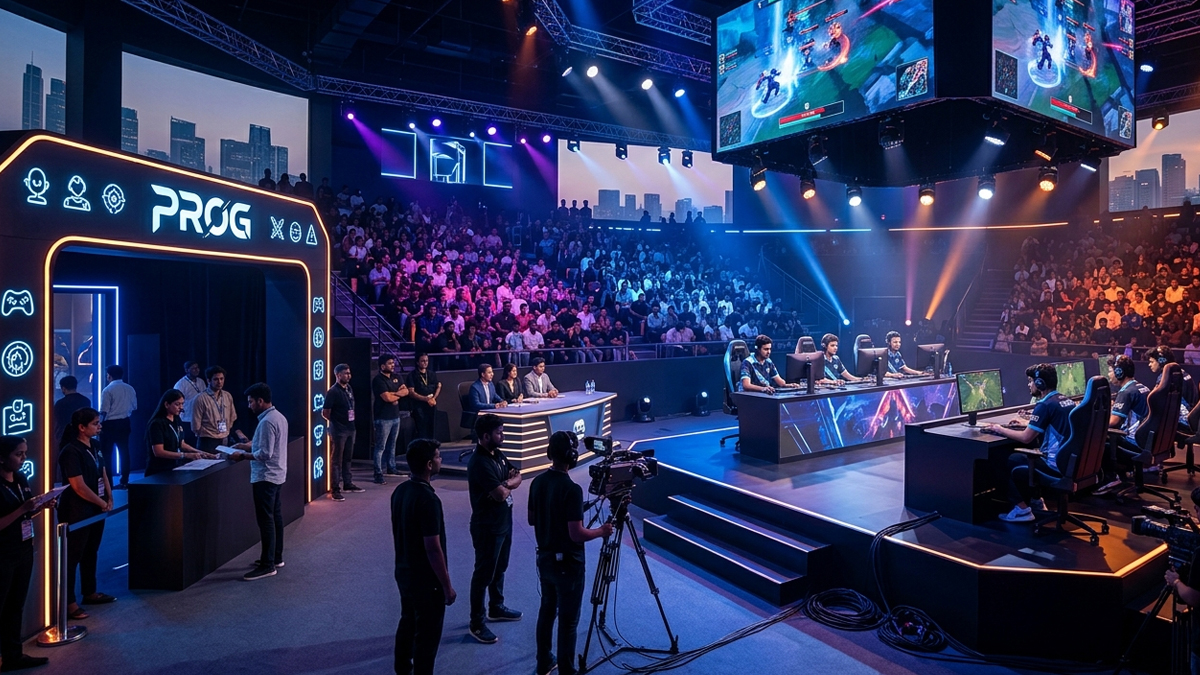
MUMBAI: For years, India’s gaming industry has lived in a strange kind of limbo, with stadiums filling up, investment pouring in, athletes competing internationally, and yet no one in government could quite agree on what to call any of it. Esports sat uncomfortably alongside fantasy apps and real-money poker rooms in the same regulatory grey zone, founders built companies on the shifting sand of legal ambiguity, and hardware makers waited patiently for a market that kept growing without ever being formally acknowledged. The industry, in short, had the audience, the talent, and the capital, just not the paperwork. That changes now.
The Ministry of Electronics and Information Technology (MeitY) has notified the Promotion and Regulation of Online Gaming Rules, 2026, a landmark framework that comes into force on the 1st of May. Finalised after extensive inter-ministerial consultations and vetted by the Department of Legal Affairs, it draws the clearest line yet between competitive gaming and gambling, hands publishers a formal path to get their titles recognised as esports, and puts a multi-ministry authority in place to govern a sector that has, until now, largely governed itself.
The framework’s most consequential move is establishing a 90-day determination process through which game publishers can formally register their titles as esports disciplines. Once registered, a title earns unambiguous recognition as a skill-based sporting pursuit, legally distinct from online money gaming and protected from the kind of misrepresentation that has long allowed real-money platforms to present themselves as esports. The rules also align esports governance across two complementary acts: technology and licensing under MeitY, and sporting oversight under the National Sports Governance Act, 2025. These are two frameworks with one clear direction and no collision.
For Akshat Rathee, co-founder and managing director of NODWIN Gaming, one of the original architects of India’s esports ecosystem, the new framework is both vindication and opportunity. He welcomed the structural clarity while also flagging one detail worth watching: a terminological choice that could place India slightly out of step with global conventions.
“The enactment of the PROG Act, 2025 brings much-needed clarity and structure to India’s esports ecosystem. The provision for formal registration of titles as esports by publishers is a particularly welcome move, as it eliminates the risk of misrepresentation and prevents proxy real-money platforms from self-declaring themselves as esports. The introduction of a 90-day determination process strikes the right balance between regulatory scrutiny and certainty. For players, teams, tournament operators, broadcasters, sponsors, and other ecosystem participants, this creates a clear signal: once registered, an esport is unequivocally recognized as a legitimate sporting discipline. The explicit exclusion of online money games from being classified as esports is another critical step. It removes ambiguity and reinforces that competitive gaming is a skill-driven pursuit independent of any wagering or monetary constructs. It is also encouraging to see that the framework recognizes esports as a publisher-led ecosystem rather than a federation-led one, aligned with technology and licensing principles under MeitY, while governance as a sport continues under the National Sports Governance Act, 2025. This dual alignment ensures both regulatory clarity and sporting legitimacy without creating parallel or conflicting structures. The composition of the authority, bringing together key ministries across technology, finance, sports, law, and internal affairs, is equipped for informed decision-making in a rapidly evolving sector. Overall, this level of clarity is a significant positive for the industry and sets a strong precedent globally. Our only suggestion would be to align the terminology with global conventions by adopting ‘esports’ instead of ‘e-sports’ to ensure consistency with international standards.”
NODWIN Gaming co-founder and managing director Akshat Rathee.
A hyphen, in the grand scheme of a sweeping regulatory overhaul, is perhaps a battle for another day. The more pressing question for the rest of the industry is what comes next, because while the welcome is warm, it is not unconditional.
Animesh Agarwal, Co-founder and CEO of S8UL, greeted the rules as a meaningful step forward, one that allows his organisation to finally plan with a longer horizon. But he was equally direct about the gaps that remain, the kind that a gazette notification alone cannot close.
“The Promotion and Regulation of Online Gaming Act, 2025 is a positive step forward for Indian esports. It brings much-needed structure to the ecosystem and clearly separates esports from online money gaming, helping address long-standing confusion around the space. For organisations like S8UL, this direction allows us to take a more long-term view – investing in talent, scaling teams, and building globally competitive structures with greater confidence. That said, there are still important gaps that need to be addressed. Esports teams and players continue to face a lack of clarity on financial frameworks, with ongoing challenges in how banks differentiate between esports earnings and real money gaming. There is also no clear pathway today to formally register esports teams as entities within a defined structure. More importantly, players and organisations still lack comprehensive protections under a clear regulatory framework. Addressing these areas will be critical for the ecosystem to move from early structure to full legitimacy and long-term sustainability.”
S8UL co-founder and CEO Animesh Agarwal
It is a fair point, and one that the industry will no doubt press further as the rules bed in. A framework that separates esports from gambling is necessary, but it is not, by itself, sufficient. The downstream questions of how professional players are taxed, how their organisations are incorporated, and what legal protections they enjoy are very much still open.
On the hardware and infrastructure side of the conversation, Vishal Parekh, chief operating officer of CyberPowerPC India, framed the development in terms of what it signals outward to the global players who have been sitting on the fence about committing to India as a gaming market.
“The enactment of the Online Gaming Act 2025 is a landmark step towards bringing structure and accountability to India’s gaming ecosystem. By formally recognising esports as a distinct, skill-based category, it addresses long-standing misconceptions that have held the industry back. The introduction of clear guardrails and enforcement mechanisms will play a crucial role in building trust, not just among players and families, but also among global partners, brands and investors looking at India as a growth market. As esports continues to gain prominence in international multi-sport events, this move strengthens India’s position in the global competitive gaming landscape. With the right ecosystem support from infrastructure to training and hardware access, we can unlock significant economic and talent-driven opportunities for the country.”
CyberPowerPC India chief operating officer Vishal Parekh
It is a perspective that carries weight. India’s esports footprint at international multi-sport events has been growing steadily, and a regulatory framework of this nature sends a signal that the country is not merely participating in the global gaming conversation; it is prepared to help shape it.
Perhaps the most tangible immediate impact, though, may be felt at the very earliest end of the industry, amongst the founders, the tinkerers, and the builders still figuring out what their companies are. Sagar Nair, head of incubation at LVL Zero Incubator, a 100-day programme designed to accelerate early-stage gaming startups across India, described the new rules as removing the single biggest headache founders in this space routinely encounter.
“The Promotion and Regulation of Online Gaming Act, 2025 is a pivotal moment for early-stage gaming startups in India. Clarity in regulation is one of the most critical enablers for innovation, and this framework helps remove long-standing ambiguity that founders have had to navigate. By clearly distinguishing esports and non-money gaming from online money gaming, the Act creates a more predictable environment for builders to focus on creating high-quality gaming experiences, scalable IPs, and globally relevant products. For emerging startups, this is an opportunity to align with a more structured ecosystem, one that encourages creativity, responsible design, and long-term value creation. With the right support across funding, mentorship, and policy stability, India has the potential to become a hub for game development and interactive media innovation.”
LVL Zero Incubator head of incubation Sagar Nair
In a sector where a single regulatory grey area can derail an entire funding round, or send an investor heading for the exit, that kind of predictability is, frankly, priceless. For the startup ecosystem, this is less about what the rules permit and more about what they finally stop leaving uncertain.
The road ahead, of course, is longer than a single gazette notification. Banks still need educating, team registration frameworks still need building, and athlete protections still need codifying. But India’s gaming industry has, at long last, what it came for: a seat at the table, a rulebook on it, and, for the first time in a very long while, a reasonably clear view of what the game actually is.