Gaming
Esports Nations Cup 2026 unveils first eight titles
Chess, CS2 and mobile hits headline global, flag-based debut

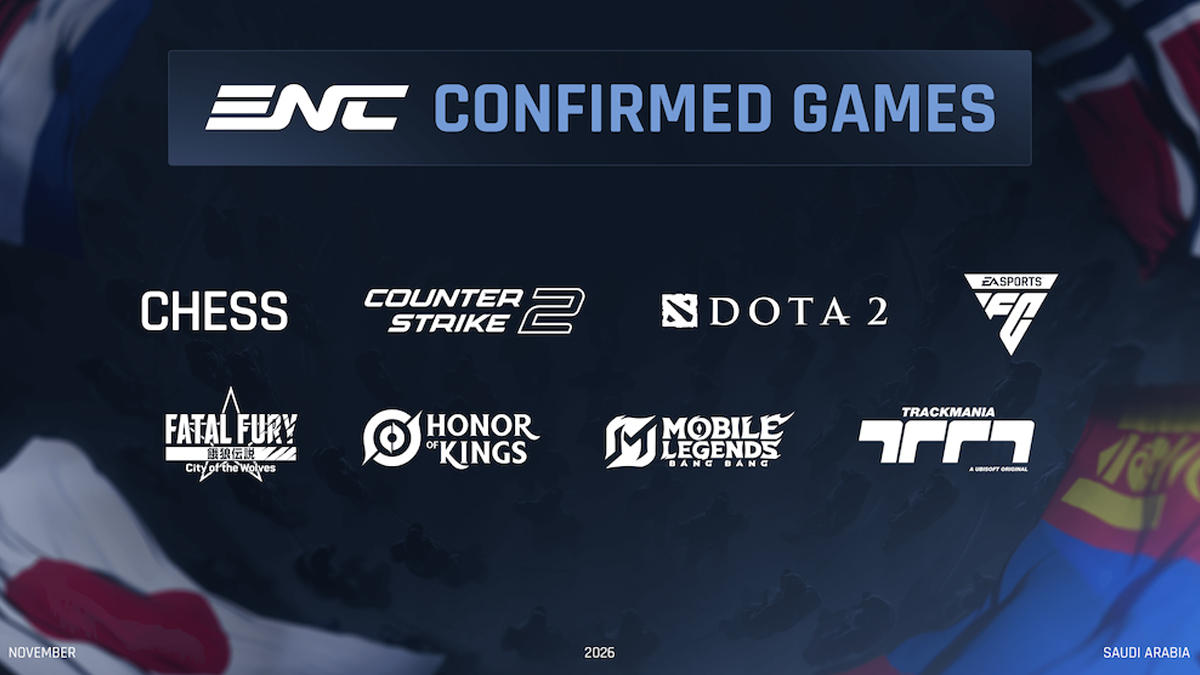
RIYADH: Riyadh is gearing up for a new kind of esports showdown, one where players will not just represent teams or brands, but entire nations. The Esports World Cup Foundation has revealed the first eight titles for the inaugural Esports Nations Cup 2026, set to run from 2 to 29 November in the Saudi capital.
The event introduces a national team format to the global esports calendar, giving players the chance to compete under their country’s flag while fans rally behind familiar colours rather than corporate logos.
The first wave of games offers a broad spread across genres and platforms. The confirmed titles are Chess, Counter-Strike 2, Dota 2, EA Sports FC, Fatal Fury, Honor of Kings, Mobile Legends: Bang Bang and Trackmania. Together, they span classic strategy, tactical shooters, fighting games, sports simulations, mobile arenas and high-speed racing.

Even with just these eight titles, the scale is significant. Thousands of players worldwide will enter qualification routes over the coming months, all chasing a place in Riyadh.
Chess will host 128 players, making it one of the largest international events in the game’s history. Counter-Strike 2 is set for a record-breaking open qualification programme, expected to involve more than 15,000 players across 3,000 teams. Dota 2 will feature 32 national sides battling through rankings, regional qualifiers and wildcard slots.
EA Sports FC will also see 128 competitors qualify through in-game pathways, regional contests and world rankings. The new Fatal Fury title will bring 32 national representatives into a fresh format aimed at spotlighting rising talent in the fighting game scene.
Mobile titles will carry serious weight too. Honor of Kings will feature 24 elite national teams, while Mobile Legends: Bang Bang will host 32 sides competing for a gold medal. Trackmania rounds out the list with a 32-player national field racing in the game’s signature four-way Cup Mode.
Eight more titles are still to be announced, completing the 16-game programme for the debut edition.
With national pride now entering the digital arena, the Esports Nations Cup aims to turn keyboards, controllers and touchscreens into a new kind of flag-bearing sport.







The stock market, FX, and derivative markets are all vastly different. However, they all share a common thread that makes them attractive for institutional and retail investors alike. These markets have deep liquidity and mature market frameworks. The reason? They are tightly regulated, which in turns attracts the capital that deepens the liquidity available.
The rules are clear and consistently applied, so big capital holders feel confident enough to make moves. Crypto markets are different, but that difference is quickly diminishing. Money goes where investors feel secure and where the rules are transparent and specific.
Liquidity Concentration as a Sign of Market Maturity
Liquidity is all about being able to match buyers and sellers quickly and cheaply. This lets retail buyers get $50 worth of Bitcoin on a Tuesday, and also lets an institutional player sell $50 million worth on the same day. The more mature and deep a liquidity pool is, the better equipped it is to handle large buy and sell orders without stumbling or creating slippage. Liquidity goes beyond just order volume. A mature market can handle stress and pressure.
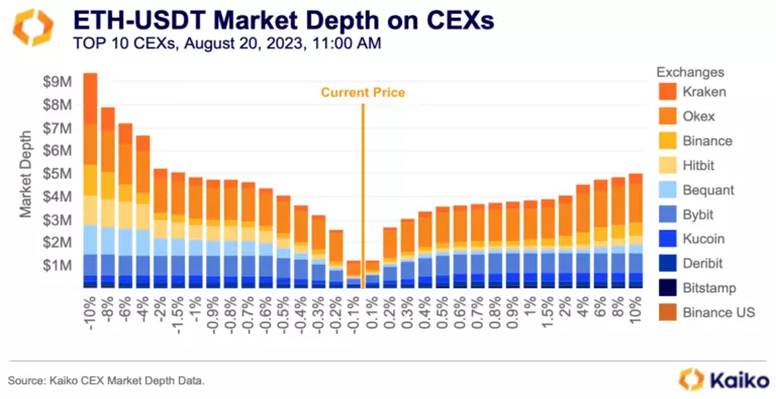
A natural outcome of market maturation is the gradual concentration of liquidity. While this may appear counterintuitive, it is a function of how efficient markets form. Consider a fragmented market made up of many small sellers offering modest amounts of an asset and a single buyer seeking to transact at scale. In such an environment, liquidity is quickly exhausted, prices become unstable, and execution becomes inefficient. This is hardly the conditions required for a reliable market. A well-functioning liquidity pool, according to CME Group, is “one where a large volume of transactions can be executed without substantial impact on the price.”
Binance’s Liquidity Scale in a Global Context
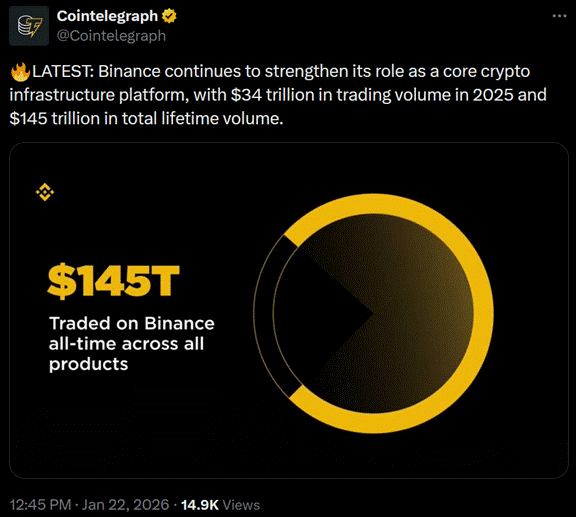
For an example on how this plays out at scale in the crypto markets let’s take a look at Binance. Crypto markets are high-velocity, meaning value changes hands quickly. Since the platform launched, their all-time trading volume is in excess of $145 trillion per Cointelegraph. To put some context to that number, the global GDP is estimated by the World Bank to be around $110 trillion. This means the company is handling trading volumes that are on-par with national financial systems.
Binance Co-CEO Richard Teng recently commented on this scale during the WEF in Davos, “As we move into 2026, I am pleased to share that we have continued to grow from strength to strength. On the user front, we crossed 300 million users globally last month. That roughly translates to 1 out of every 20 adults in the world is using the Binance platform for investing.”
Teng continued, “Binance remained a primary venue for global crypto liquidity, with $34 trillion traded on the platform in 2025 and spot volume exceeding $7.1 trillion, about a 20% increase in average daily trading volume across all products. All-time traded volume reached $145 trillion across all products—more than the annual global GDP.”
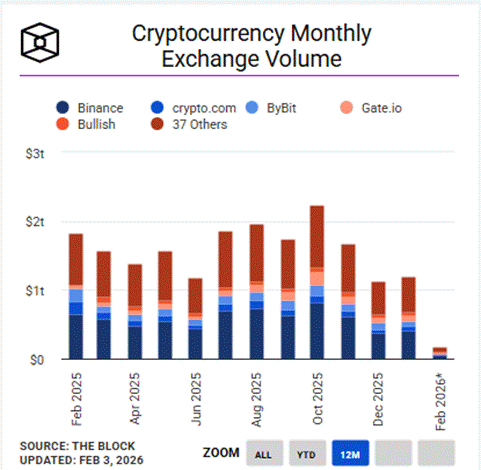
According to CoinGecko data shared by Wu Blockchain, Binance’s spot trading volume rose from $365B in December 2025 to $409B in January 2026, marking a +12.1% month-over-month increase. This is nearly 5X larger than the next exchange.
Why Compliance Attracts Professional Capital
A 2026 report from PwC notes that “Institutional involvement has crossed the point of reversibility.” Blockchain technologies are being used behind the scenes to move large volumes of value. These moves are so deeply embedded in the fabric of the world’s financial infrastructure that trying to remove them could be costly. Financial markets are using these technologies already, so the regulators catching up has become essential.
It’s also essential to understand how professional capital views risk. Smaller players will focus on upsides and first-move advantages, but the professionals care first about legal risk which is non-negotiable. When doing business in any market, professional capital must know that what they are doing is permitted (and not in a gray area), who is overseeing it, and what are the risks or likelihoods of sudden rule changes.
Professional capital isn’t cautious by choice, but instead by the fact that they answer to auditors, regulators, company boards, and their own fiduciary responsibilities. Compliance means their need for caution has been fulfilled.
Market Integrity as a Competitive Moat
Integrity in crypto markets is all about predictability from market participants. We know there are no front runners or hidden fees because we can see the fee schedule and order book live. Market makers and professional capital only use markets with integrity because it makes things predictable and ensures everyone is following the same rules.
Market integrity thus acts as a defensive layer that keeps dishonest players from attracting professional capital. Integrity is made up of three parts: surveillance, controls, and transparency. IOSCO formalizes these, writing in a report that regulators must verify entities like crypto exchanges “for the monitoring, surveillance and supervision of the exchange or trading system and its members or participants to ensure fairness, efficiency, transparency and investor protection, as well as compliance with securities legislation.”
Liquidity as the Ultimate Vote of Confidence
What this all tells us is fairly simple. Liquidity goes where investors are confident. Professional capital has more needs than retail capital. When their needs are met, they vote with their resources by deploying value into pools they trust the most. That trust comes from regulation, market integrity, and above all, confidence in the pool itself.
Disclaimer:This article has been published without the journalistic or editorial involvement of indiantelevision.com, IndianTelevision.com Group, or any of its affiliated websites. IndianTelevision.com Group does not endorse, subscribe to, or take responsibility for the content, opinions, or views expressed herein.
Readers are further advised that Online Casino, Betting, Cryptocurrency products, Financial Investments/Engagements, NFTs, and products or calls-to-action related to Health, Booking, Wellness, and Food are largely unregulated and carry significant risk. There may be no regulatory protections or avenues for recourse in the event of financial losses or health-related risks arising from engagement with such products or services.
IndianTelevision.com Group expressly disclaims any responsibility or liability for the information, views, announcements, declarations, or affirmations presented in this article. By choosing to proceed, the reader acknowledges and agrees that they do so at their own discretion and risk, and expressly absolve indiantelevision.com (IndianTelevision.com Group) from any potential legal claims, liabilities, or actions.