DTH
DTH operators against imposition of further regulation on platform services


MUMBAI: Major direct-to-home (DTH) operators spoke against the imposition of any registration fee or annual fee for the platform services (PS) offered by them. Tata Sky, Dish TV, Bharti Telemedia the holding company of Airtel Digital TV are of the view that as DTH operators already pay license fee and furnish bank guarantee, there should not be any requirement of any additional payment for PS. The companies have also delivered their views against capping the number of PS channels.
The Telecom Regulatory Authority of India (TRAI) issued a consultation paper (CP) on issues related to PS aimed at a proper regulatory framework for the services in late August. Before the CP was floated, the Ministry of Information and Broadcasting (MIB), in a letter dated 2 July 2019, sought the recommendations of TRAI on various issues related to PS with reference to DTH guidelines. TRAI also mentioned in the consultation paper that unlike private satellite TV channels which are permitted and regulated under the uplinking and downlinking guidelines of MIB, PS is not subject to any specific regulations or guidelines as of now.
As TRAI invited comments on the consultation paper from the stakeholders Tata Sky, Dish TV, Bharti Telemedia submitted their comments on the issue:

“Platform Services (PS) are programs transmitted by distribution platform operators (DPOs) exclusively to their own subscribers and does not include Doordarshan channels and registered TV channels. PS shall not include foreign TV channels that are not registered in India,” TRAI defined PS in its Recommendations on Regulatory Framework for Platform Services dated 19 November 2014.
Here are the important questions raised in the CP and the comments by the mentioned companies:
What should be the Registration fee/Annual fee for PS per channel? And how it is to be estimated?
All three players have commented that there should not be any requirement of any additional payment by DTH operators applicable for a PS channel as the DTH operators are required to pay entry fee, license fee and also furnish bank guarantee. They also mentioned in the submission that other distribution platform operators like MSOs, LCOs, HITS are not paying such fees which already creates a non-level playing field. Dish TV also mentioned that the requirement for payment annual fee can be imposed on cable platforms who are not required to pay any kind of entry or license fee to the government.
The maximum number of PS channels that can be offered by DTH operators:
According to the submissions made by the DTH players, there should not be any cap on the number of PS channels offered by the service providers. One of the reasons that has been highlighted is that DTH operators provide pan-India service and need to cater to customers of varied tastes and languages. Moreover, at a time when the broadcasters are having their own over-the-top platforms, limiting the number of PS would harm DTH operators in the competition.
“If the authority still feels that a limit is required, then it should be sufficient for us to grow further beyond the number of channels that we already have, and the limit should also be flexible going forward so that we may not be required to approach MIB and TRAI for cap enhancement. Additionally, for maintaining parity, similar caps should also be placed on MSOs/ LCOs,” Tata Sky commented.
Is there a need to revisit/review the earlier recommendations of the Authority dated 11th November, 2014, relating to keeping recording of all PS channel programs for a period of 90 days and maintaining a written log/ register of such program for a period of 1 year by the DPO from the date of broadcast and the role of Authorised Officer and the State/ District Monitoring Committee and MIB as monitoring authorities:
Article 8 of the DTH license condition mandates DTH operators to maintain the recoding of the programs carried on the platform for a period of at least 90 days at its own cost which is also applicable on PS carried by the operators. In addition to that, all the content transmitted by DTH operators are monitored by the Electronic Media Monitor Center which is entrusted with the responsibility to check the compliance of the ‘Programme and Advertisement Code’ under the Cable TV Network (Regulation) Act, 1995. Hence, they are of the view that there is no requirement for prescription of any additional compliance maintaining a written log/ register of such program for a period of one year by the DPO.






DTH
Dish TV launches ‘Kuch chhota sa’ campaign for TV flexibilit
New campaign highlights 190+ channels, Always-On service, Rs 99 Freedom Pack.
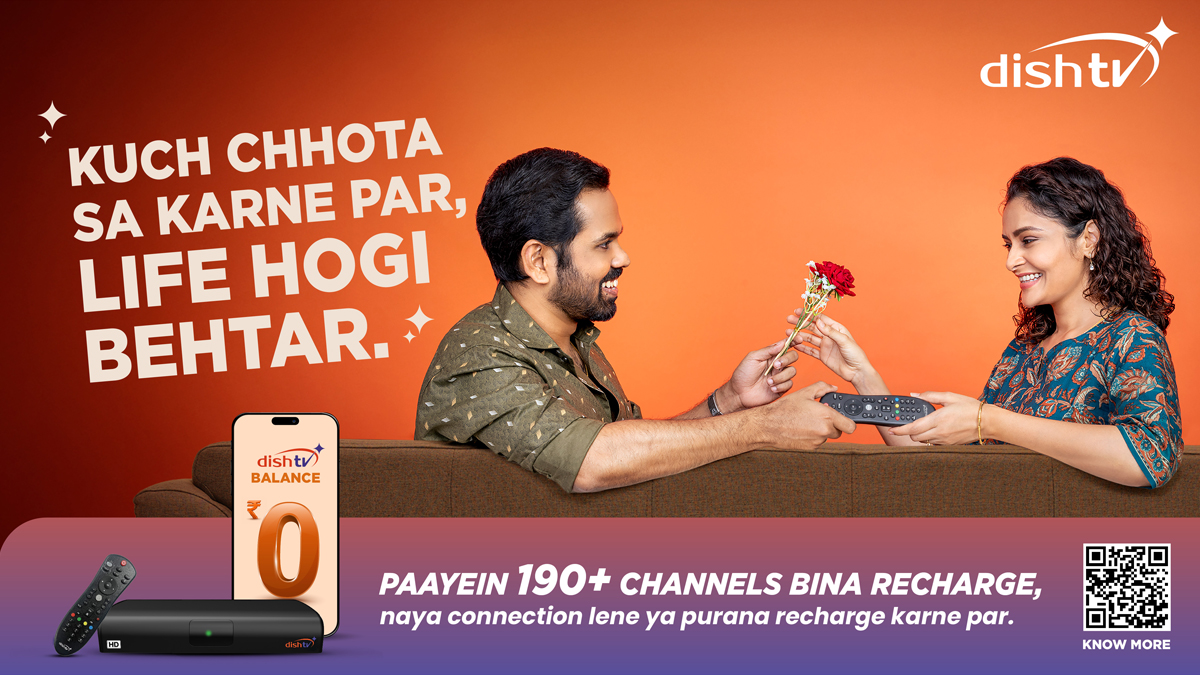
MUMBAI- Sometimes, the smallest remote click can fix the biggest daily friction and Dish TV is betting on exactly that insight. The company has rolled out a new campaign built around the thought ‘Kuch chhota sa karne par, life hogi behtar’, turning everyday viewing annoyances into a case for simpler, more reliable television access.
The campaign taps into a familiar household reality: millions of viewers continue to rely on free-to-air channels but increasingly want the flexibility of premium content, often ending up with a patchy and inconsistent viewing experience. Dish TV positions itself as the middle path—a structured yet flexible alternative that promises continuity without complexity. At its core is the pitch of an “Always-On” service, designed to keep content accessible even when recharge timelines slip, effectively reducing one of the most common friction points in DTH consumption.
To strengthen this proposition, the platform is offering access to over 190 channels, alongside a flexible pricing hook through its Freedom Pack, starting at Rs 99. The pack is positioned as a seasonal companion particularly relevant during high-engagement periods such as cricket tournaments, school holidays and festive windows, when content consumption spikes but users may not want long-term commitments.
Conceptualised by Enormous, the campaign unfolds through two master films and three short edits rooted in slice-of-life storytelling. From a husband quietly navigating around his sleeping wife to siblings striking a compromise over a coveted window seat, the narratives lean into humour and relatability rather than heavy messaging. The underlying idea remains consistent: small adjustments can meaningfully improve everyday experiences.
The rollout spans a full 360-degree media mix, including television, digital platforms, on-ground activations, point-of-sale visibility, Google Display Network placements and influencer-led content, signalling a push for both scale and contextual engagement.
As viewing habits continue to evolve in a hybrid ecosystem of free and paid content, Dish TV’s latest play reflects a broader industry shift where reliability and flexibility are increasingly positioned as differentiators, not just add-ons. In a market crowded with choice, the brand’s wager is simple: sometimes, it’s the smallest tweak that keeps audiences tuned in.