Cable TV
LCOs and new tariff order challenges

MUMBAI: With the evolution of television, cable industry has gone through various challenges from competing with DTH operators to digitisation to NTO. Although implementation of NTO was the biggest challenge for the cable industry, it managed to overcome all the challenges they came across. Going ahead LCOs are also gearing up for challenges with OTT apps with its Hybrid boxes. The industry experts gathered to discuss how has the role of the LCO changed under the new regulatory framework and its significance going forward at VBS 2019.
Video and Broadband Summit 2019 orgainised by Indiantelevision.com on11 December gave the platform to the DPOs, MCOs and LCOs to discuss the issues faced by them. One of the panel discussions of VBS 2019 highlighted the role of LCOs post NTO where the experts discussed the impact of NTO on cable industry, technical challenges they came across, customer churns in the transition period of NTO, and importance of educating LCOs on bouquets and a la carte prices.
The panel was moderated by One Take Media co-founder and chief executive officer Anil Khera. On the panel were IndusInd Media & Communication Ltd. chief operating officer N K Rouse; ABS Group of Companies MD & chairman Atul Banwarila Saraf; Maharashtra Cable Operators Federation (MCOF) president Arvind Ramesh Prabhoo; UCN Cable Network Pvt Ltd head – operations Debashis Mohanty and Ashwini Cable Santosh Yadav.

Khera set the tone of the discussion by briefing the audiences on the challenges faced by LCOs till date and how they have overcome all those challenges successfully. NTO was the biggest challenge for the industry, Rouse explained that the new NTO, for his company was not a new tariff order, but was a new technical order and his company had to face lot of technical challenges to implement the new NTO.
“In the initial stage there was a lot of confusion. With the top five broadcasters, for 335 bouquets or packs, we have more pay channels and DPO packs. Customers were confused as they were not sure what to select. We had challenges in convincing the customers as everything was new. But as things settled down, the viewership pattern had changed with lots of ups and downs but still packages keep coming and going,” he said.
“There was a saying that content is the king and distribution is the God. The time has come that content remains the king, but God has changed. Now customer chooses the God. We all have to come and work together and ensure that we take care of the customer’schoice. Challenges will keep coming and there will be amendments in NTO, but things will settle down. I look forward for collaboration with the stakeholders and I am sure things will turn positive,” he opined.
There has been 15 to 20 per cent of customer churn in the transition period of NTO. Saraf said in the last six to eight months, he has observed that people in small towns are still using TV and there is a trend of using two or three TVs in one house. To get these customers back, LCO needs to be educated, but MSOs are not able to educate these customers as the customers themselves are not ready to educate themselves.
Saraf also said, “Though operators and MSOs like us are not much happy post NTO, we are able to compete with big MSOs at the same cost. We do not deny entry to the new areas as our preposition of expansion is different and we can expand our business.” He further added that there are lots of things which small MSOs can build among their LCOs, as compared to big MSOs. For big MSOs, it is difficult to control 10 – 15 thousand of LCOs. A limited number of LCOs can be controlled and good business can be built post NTO.
Prabhoo believes that transformation has already started but is unaware of how much the MSOs are assisting FTH with the transformation. He added that the network is operated and owned by the last mile owner and it will be the responsibility of the last mile owner to upgrade the network.
The panellists also agreed that they have to make sure to reach platforms like Netflix or Amazon and for that LMOs have to immediately upgrade to DTHs and then MSOs will be able to help them to launch a wide OTT platform. Once this happens, cable networking can be similar to that of an OTT platform.
Mohanty said, “As per the customer’s perspective, there is a demand for content. Customers will return to MSOs, if MSOs come up with OTT content and provide a number of services as per the customer’s choice. Most of the time, LCOs have 50 per cent digital connection, so they have enough manpower to upgrade their network. Once MSOs upgrade their network, it can provide services as per the customer’s demand.”
He also informed that they have started hybrid boxes. Once the hybrid boxes are installed at the customer’s place, customers can view both offline and online content.
Saraf said that five years back the market was not up with the hybrid boxes and LCOs were not ready toinvest in it. Now from last 2 – 3 years we have OTT platforms and hybrid boxes. Now FTTH will create something which will influence the customers and LCOs to invest in hybrid boxes.
Yadav replied to Khera’s question of cable collaborating with broadband, “NTO implementation has been big for the LCOs and there has been increase in the operating cost of the LCO. So LCO has to provide additional services like broadband. LCO can tie up with the MSOs and go ahead with the existing costumers. I believe that all LCOs do not have their 100 per cent base and so they already have chosen for their cableservices. They can advertise and can assure that they can provide good services by upgrading their infrastructure.”
On NTO Prabhoo commented, “I am not sure if the NTO’s image’s in true spirit has been implemented or not or if the customers have understood that what NTO has started to provide them. During the pre-digitisation era the NTO was under declaration by the LMOs. When digitisation came in, each and every set-up box was accounted with LMOs and with MSOs. He said he is unaware if broadcasters benefited from that. But in the post NTO there has been 15 to 20 per cent drop in the subscriber base, but ARPU has increased in a particular rate.”
Rouse commented, “When NTO was implemented few broadcasters thought that there will be a drop in the base. There was a massive fall from DTH or videos but I am sure we could retain some customers. More transparency is required as customers have made a choice, for which some laws have to be implemented.”




Cable TV
Hathway Cable appoints Gurjeev Singh Kapoor as CEO
Leadership change comes as cable TV faces shrinking subscriber base and modest earnings pressure
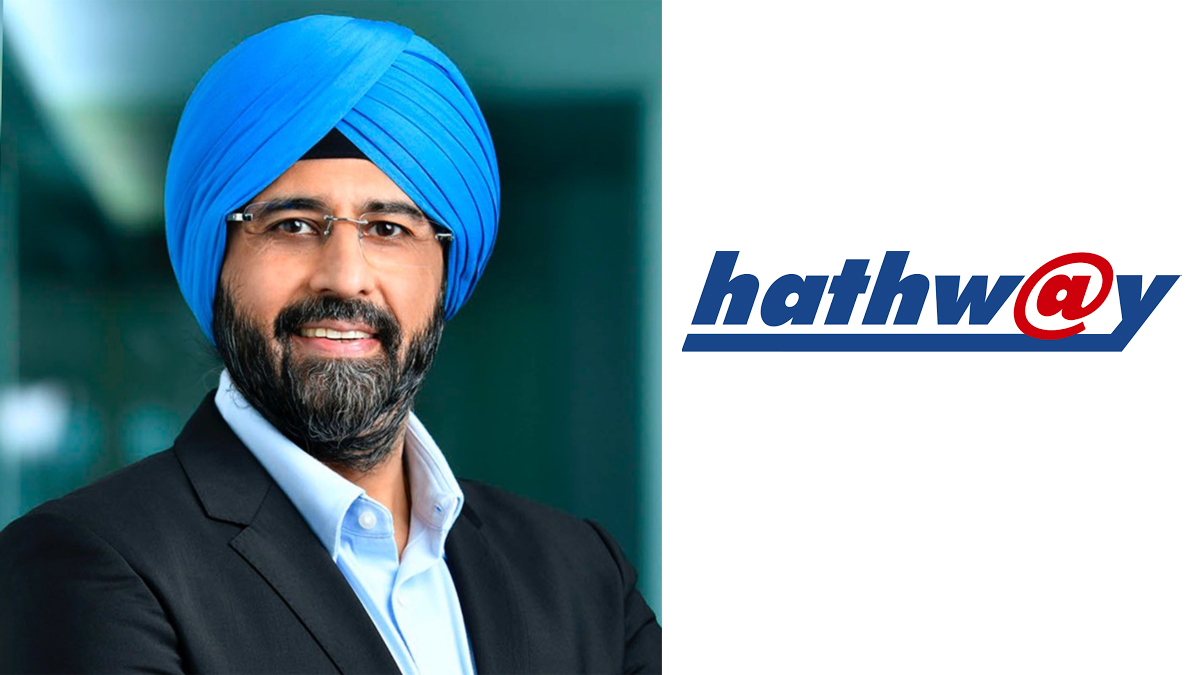
MUMBAI: Hathway Cable and Datacom has tapped industry veteran Gurjeev Singh Kapoor as chief executive officer, marking a leadership pivot at a time when India’s cable television business is under mounting strain.
Kapoor will take over from Tavinderjit Singh Panesar, who is set to retire in August after a long innings with the company. Panesar, chief executive since 2023, has held multiple leadership roles at Hathway, including his latest stint beginning in 2022.
Kapoor brings more than three decades of experience in media and entertainment. He most recently led distribution at The Walt Disney Company’s Star India business, now part of JioStar. His career spans television distribution and affiliate partnerships, with stints at Sony Pictures Networks India, Discovery Communications and Zee Entertainment.
Panesar, with over three decades in the industry, has worked across strategic planning, distribution and business development in media, broadcasting and manufacturing. His past associations include ESPN Star Sports, Star India, Apollo Tyres and JK Industries.
The transition lands as the cable sector grapples with structural disruption. Traditional operators are losing ground to streaming platforms, while telecom and broadband players tighten the squeeze with bundled offerings.
An EY report estimates India’s pay-TV base could shrink by a further 30 to 40 million households by 2030, taking the total down to 71 to 81 million. The slide follows a loss of nearly 40 million homes between 2018 and 2024, a contraction that has already wiped out more than 37,000 jobs in the local cable operator ecosystem.
Hathway’s numbers reflect the strain. The company reported a consolidated net profit of Rs 93 crore for FY25, down from Rs 99 crore a year earlier. Revenue inched up to Rs 2,040 crore from Rs 1,981 crore. As of December 2025, it had about 4.7 million cable TV subscribers and roughly 1.02 million broadband users.
Kapoor steps in with a familiar brief but a shrinking playbook. In a market where viewers are cutting cords faster than companies can reinvent them, the new chief executive inherits a business fighting to stay plugged in.







